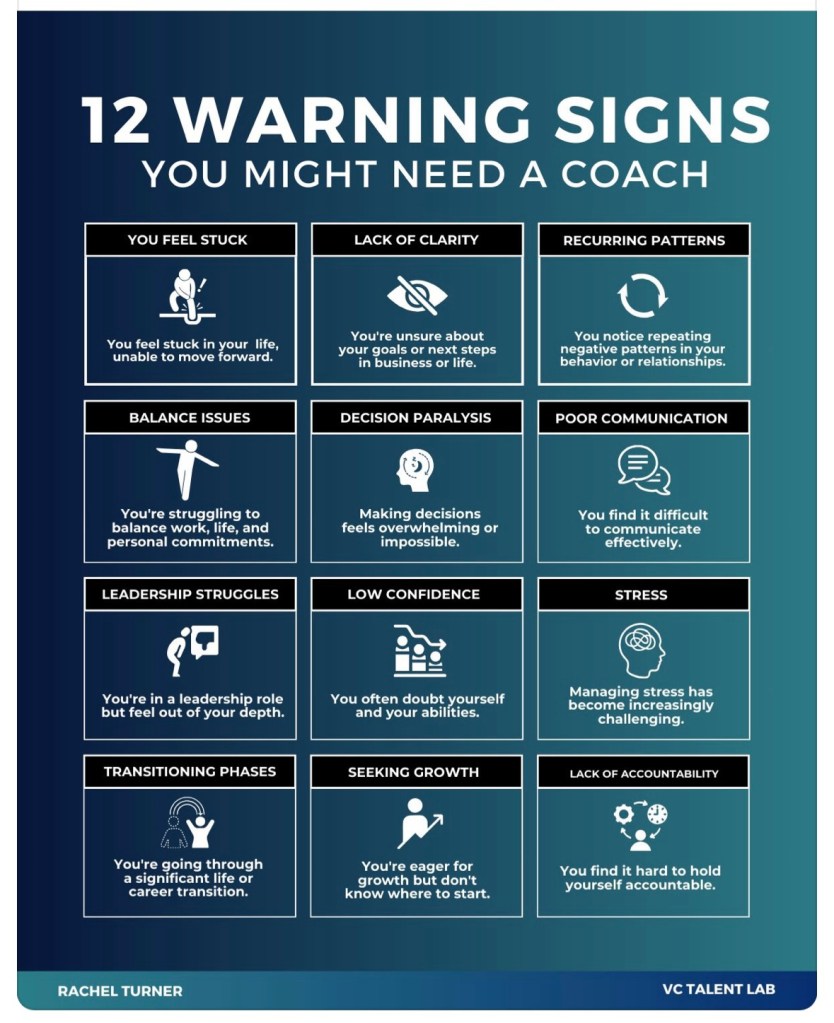
The 12 warning signs you might need a coach a stellar Rachel Turner share. A list you would be mad to miss:
You feel stuck. You feel stuck in your personal or professional life, unable to move forward.
Lack of clarity. You’re unsure about your goals or next steps in life.
Recurring negative patterns. You notice repeating negative patterns in your behavior or relationships.
Balance issues. You’re struggling to balance work, life, and personal commitments.
Decision paralysis. Making decisions feels overwhelming or impossible.
Low confidence. You often doubt yourself and your abilities.
Communication challenges. You find it difficult to communicate effectively in personal or professional settings.
Leadership struggles. You’re in a leadership role but feel out of your depth.
Chronic stress. Managing stress has become increasingly challenging.
Transitioning phases. You’re going through a significant life or career transition.
Seeking growth. You’re eager for personal or professional growth but don’t know where to start.
Lack of accountability. You find it hard to hold yourself accountable.
Here’s what a coach can do:
✨ Provide clarity in your chaos. ✨ Offer unbiased feedback. ✨ Help you identify and break negative patterns. ✨ Guide you through life’s transitions. ✨ Boost your decision-making skills. ✨ Elevate your leadership abilities.
Because sometimes, the only thing standing between you and your goals is you.
You cannot escape the responsibility of tomorrow by evading it today.
Abraham Lincoln
A colleague shared her exhaustion with what she termed as her habitual procrastination. She was tired of incomplete tasks in her life and asked for help.
Avoiding procrastination is essential for leaders and professionals to maintain productivity and achieve goals. Here are 9+ key points shared to help overcome this practice.
1.Self-Awareness
Recognize your procrastination habits and understand the underlying causes. Self-awareness is the first step to change.
2.Prioritization
Prioritizing tasks is essential. Leaders should focus on high-impact, high-priority activities first.
3.Set Clear Goals
Set specific, measurable, achievable, relevant, and time-bound (SMART) goals. Having clear objectives provides motivation and direction.
4.Time Management
Use effective time management techniques, such as time blocking, to help you allocate your time efficiently.
5. Break Tasks into Smaller Steps
Practice breaking larger tasks into smaller, manageable steps. This makes tasks less daunting and more achievable.
6.Delegation
Trust more. Delegate tasks to capable team members when possible. Delegation frees up time for strategic thinking and higher-priority activities.
7. Overcoming Perfectionism
Are you a perfectionist? Often this tendency fuels procrastination through delaying completing projects until they are perfect. Focus on progress, not perfection.
8. Accountability
Set up an accountability system, such as working with a mentor, coach, or a peer who can hold you responsible for deadlines and commitments.
9. Eliminate Distractions
Identify strategies to minimize distractions, whether it’s turning off notifications, setting specific work hours, or creating a clutter-free workspace.
10. Self-Motivation
Identify your intrinsic motivation. What drives them to succeed? Connecting with their personal “why” can provide the push you need.
11. Time for Self-Care
Practice taking regular breaks and prioritize self-care. A well-rested and healthy leader is less likely to procrastinate.
12. Mindfulness and Focus
Adopt mindfulness practices and techniques that can improve focus and attention, reducing the temptation to procrastinate.
13. Positive Self-Talk
Replace negative self-talk with positive affirmations. Confidence can help combat procrastination.
14. Celebrate Achievements
Acknowledge and celebrate your accomplishments, no matter how small. Positive reinforcement can reinforce productivity.
15. Continuous Improvement
Focus on the concept of continuous improvement. As a Leader, it is important to regularly assess your time management and productivity strategies and adjust as needed.
16. Seek Professional Support
If procrastination is chronic and significantly hinders your leadership effectiveness, seek support from a therapist or counselor who specializes in procrastination or time management issues.
As a certified Master leadership coach, I provide support, guidance, and accountability to leaders to help them work to overcome procrastination. Implementing the strategies articulated here and developing healthy habits will lead to more effective and efficient leadership.
Want to succeed in the new year? Set goals! It’s a big deal because setting goals can help you get where you want to be. The 10 steps that follow make it super simple for you. Whether you’re a leader, professional or just someone who wants to grow, these steps will guide you through the strategies to set goals that really work. The aim is to help you stay motivated and focused on your path to success.
Define the Objective: What is the specific area or aspect of life where you want to set a goal? What is the purpose of this goal?
Step 2: SMART Goals
Specific: Make the goal specific, avoiding vague language. What exactly do you want to accomplish?
Measurable: Ensure the goal can be quantified in some way. How will you measure your progress and know when you’ve achieved it?
Achievable: Assess whether the goal is realistic and attainable. Is it within your reach, given your current resources and constraints?
Relevant: Does the goal align with your values, long-term objectives, and the bigger picture of your life. Is it meaningful?
Time-Bound: Set a clear timeframe or deadline for achieving the goal. When will you complete it?
Step 3: Break It Down
Break It Into Smaller Steps: Divide the larger goal into smaller, manageable tasks or milestones. What steps need to be taken to reach the goal?
Step 4: Prioritize
Prioritize Tasks: Determine the order of importance for each task. Which steps should be tackled first, and which can follow?
Step 5: Visualize Success
Create a Mental Image: Ask the individual to visualize themselves successfully achieving the goal. How will it feel? What will it look like?
Step 6: Identify Obstacles
Recognize Challenges: Reflect on potential obstacles, difficulties, or setbacks you may encounter on your journey to the goal. How can you prepare to overcome these challenges?
Step 7: Develop a Plan
Create an Action Plan: Outline the tasks, deadlines, and resources required to achieve the goal. What specific actions will you take?
Step 8: Monitor and Adjust
Regular Review: Emphasize the importance of monitoring progress regularly. How are you doing in relation to the goal? Are you on track?
Adjust and Adapt: Be flexible in adapting the plan as needed. If you encounter unexpected obstacles or need to change your approach, how will you do so?
Step 9: Accountability
Accountability Partners: Have an accountability partner, such as a coach, mentor, or friend, who can provide support and hold you responsible for your commitments.
Step 10: Celebrate Success
Acknowledge Achievements: When you reach your goal, celebrate the achievement. Do some self-reflection and recognition of your progress.
By following this step-by-step process, you can set and achieve goals that align with your values and aspirations.
Need an accountability partner to help you set your goals and stay on track? Let’s connect
Be exposed to exclusive insights from accomplished beauty pageant contestants who have mastered the art of goal-setting and achieving remarkable success.
In this captivating video, you will be exposed to exclusive insights from accomplished beauty pageant contestants who have mastered the art of goal-setting and achieving remarkable success.
Listen in as Miss Universe Trinidad & Tobago Dalise Lockhart and Miss New England Petite, Kimberly Campbell share their personal journeys, strategies, and invaluable wisdom on setting and reaching your aspirations.
Discover the secrets to turning dreams into reality
Overcoming obstacles
Staying motivated on your path to success.
Whether you’re striving for success in pageantry, your career, or life in general, these beauty queens’ experiences and expertise will provide you with practical tips and inspiration to help you unlock your full potential.
Don’t miss out on this empowering conversation with some of the most accomplished individuals in the world of beauty pageants. Share with your friends who are on their journey to achieving greatness. Get ready to ignite your passion, set ambitious goals, and embark on a journey to success. Lean in and listen and let’s begin this exciting adventure together!
Stress acts as an accelerator. It will push you either forward or backward, but you choose which direction.
Chelsea Eriean
Workplace stress can arise from various sources, and it affects employees across different industries and roles. Understanding the common causes of stress at work is crucial for both employees and employers to take appropriate measures to manage and mitigate its impact. Here are some key factors that contribute to work-related stress:
Excessive Workload: Overwhelming work demands, tight deadlines, and a constant flow of tasks can lead to stress as employees struggle to cope with the pressure to perform.
Lack of Control: When employees feel they have little control over their work, decision-making, or the outcomes of their efforts, it can lead to a sense of helplessness and increased stress.
Job Insecurity: Fear of job loss or instability due to economic conditions, restructuring, or organizational changes can create anxiety and stress among employees.
Long Working Hours: Extended work hours, lack of work-life balance, and overtime can leave employees feeling drained and overwhelmed, contributing to chronic stress.
Unclear Expectations: Ambiguous or constantly changing job roles, responsibilities, and performance expectations can create confusion and stress for employees.
Lack of Recognition: When employees’ efforts and achievements go unnoticed or unappreciated, it can lead to feelings of disengagement and stress.
Poor Working Relationships: Conflict with coworkers, difficult supervisors, or a negative work environment can significantly impact employees’ mental well-being.
Organizational Culture: Toxic workplace cultures that promote competition, lack of support, or an absence of work-life balance can foster stress among employees.
Career Advancement Pressures: The desire to progress in one’s career, coupled with intense competition, can lead to stress as employees strive to meet expectations.
Workplace Bullying or Harassment: Acts of bullying, discrimination, or harassment create a hostile work environment, triggering stress and anxiety in affected employees.
Lack of Resources: Insufficient tools, training, or support can hinder employees from effectively fulfilling their job responsibilities, leading to stress.
Workplace Change and Uncertainty: Frequent organizational changes, such as mergers, restructuring, or new management, can generate stress due to uncertainty and adjustment challenges.
Job Demands and Complexity: Highly demanding and intellectually challenging roles may lead to stress, especially when coupled with limited resources or support.
Physical Work Conditions: Uncomfortable or unsafe work environments can negatively impact employees’ mental and physical health, contributing to stress.
Personal Life Interference: When personal issues, such as family problems or health concerns, spill over into work, it can intensify stress levels.
Addressing these causes of workplace stress involves creating supportive work environments, implementing stress-reduction programs, promoting work-life balance, providing opportunities for coaching, skill development and growth, and fostering open communication between employees and management.
Never hesitate to go far away, beyond all seas, all frontiers, all countries, all beliefs.
Amin Maalouf
With just a carry-on, I felt led to travel solo to a faraway land. Was it nerve racking? Kinda. I travelled without fear, more intrigued by curiosity while discovering the unknown. Most of all my learnings forced me into a new realm bursting forth with a new sense of unhurried flair.
Here I share a few of learnings:
Learned self-confidence. To be confident in who I am and who I want to be.
I learned to accept differences in cultures
I learned to accept the uniqueness of different lifestyles
I learned to say YES to myself, to what I want and to say No to the desires that others want for me.
I learned to hold firmly to my belief to never give up.
I learned to grow up and out to spread my wings.
I learned to try things that force me out of my comfort zone.
I learned to take rests.
I learned to take risks and not be afraid or most importantly, to take the risk even when I am afraid, despite my fear
I learned that education is critical to success but also to have a life.
I learned to be me.
I learned to not be of afraid to be me – to speak the way I want to speak.
I learned to write to help others through coaching.
I learned to express myself in writing to help others develop and maximize their potential.
I learned to laugh.
I learned to accept life’s simple things.
I learned to love dogs and animals.
I learned to accept help from others despite my independence.
I learned to accept love from others
I learned to accept what success means to me and not what others expectations are for me.
I learned to challenge myself to step out into the unknown.
You know those things you have always wanted to do, you should go do them.
What is it that thing you have always wanted to do? Change job? Start a family? Enroll on that degree? Learn a new skill? Take that vacation?
Life gets hard at times. Chances are with everything happening around us at work, home, school, it can knock us off our feet. The result often is being stuck. Not moving. As in a state of shock, standing still. Below are 7 Things you can do when you are stuck.
Do something! Step out! Complete that application! Try something new!
Plan an escape rather than daydream about different scenarios. Go on a trip to relax and reboot your thoughts.
Switch up your daily activities.
Don’t envy and compare yourself to others.
Do one positive thing for yourself today.
If you want to change your life, Pray. Change your…