15 Steps To The Ideal Career For The New Ambitious Professional …

Natalie, a frustrated high school graduate, had been in and out of jobs for four years after graduating high school. She was referred for coaching because she was annoyed at the way employers treated her and she refused to accept it. The lack of income did not help as she needed to meet her needs.

This situation is common among young adults who are in the early stages of their career and ‘waiting’ for their ideal job (and yessss among others with years of experience too). The 15 Strategies listed can be adapted to secure employment, gain valuable experience and bring you closer to your ideal career.

Career Goals: 15 Steps To Success

1. Apply For Entry-Level Positions
  • Target entry-level positions in your field of interest.
  • Look for internships, apprenticeships, or part-time positions to gain hands-on experience.
2. Enhance Your Resume
  • Highlight relevant skills, coursework, and any extracurricular activities.
  • Tailor your resume for each application to match the specific job requirements.
3. Networking
  • Attend industry events, workshops, and networking mixers.
  • Connect with professionals on LinkedIn and engage in conversations.
4. Online Job Platforms
  • Explore job search platforms like LinkedIn, Indeed, Glassdoor, and company websites.
  • Set up job alerts to receive notifications for relevant positions.
5. Temporary Work or Freelancing
  • Consider taking temporary positions or freelancing opportunities to build your skills and network.
  • Platforms like Upwork or Fiverr can be good for freelancing gigs.
6. Professional Development
  • Take online courses or certifications to enhance your skills.
  • Mention ongoing learning initiatives on your resume to showcase your commitment to personal and professional development.
7. Volunteer Work
  • Offer your time to non-profit organizations or community projects.
  • Volunteering can provide valuable experience and demonstrate your dedication.
8. Informational Interviews
  • Reach out to professionals in your field for informational interviews.
  • Gather insights, seek advice, and express your eagerness to learn from their experiences.
9. Create Online Portfolio
  • Build an online portfolio showcasing your projects, coursework, or any freelance work.
  • Include a link to your portfolio on your resume and LinkedIn profile
10. Skill Development
  • Identify skills in demand within your industry and work on acquiring them.
  • Online platforms like Coursera, Udemy, or Skillshare offer a variety of courses.
11. Professional Social Media Presence
  • Ensure your LinkedIn profile is complete and professional.
  • Share relevant content and engage with professionals in your field.
12. Industry Research
  • Stay informed about trends and changes in your desired industry.
  • Use this knowledge to tailor your applications and interviews.
13. Career Counseling Services
  • Seek guidance from career counseling services offered by educational institutions or career centers.
  • They can provide insights into job opportunities and help you refine your career goals.
14. Participate in Job Fairs

Attend job fairs, both virtual and in-person, to connect with employers and explore potential opportunities.

15. Soft Skills Development
  • Work on developing essential soft skills such as communication, teamwork, and adaptability.
  • These skills are often highly valued by employers.

Remember, the job search process can take time, and being open to various opportunities can lead to unexpected but valuable experiences. Stay persistent, connect with a coach, maintain a positive attitude, and continuously refine your approach based on feedback and experiences.

Cheers to a revealing journey of learning!

New Entrepreneurs Growing Pains: 5 Factors To Consider

Entrepreneur Growing Pains

Joy was excited about launching her business and she did! Now six months later, she has been finding it difficult to survive financially. With rising debt and living expenses, she is unable to make ends meet. She reached out for coaching to tackle her inner stress while pondering if she had made a mistake.

This situation is common to many first-time entrepreneurs. Statistics show that many small businesses fail during the first year. Most ponder giving up or staying the course. The decision between working on their new business or getting a job often depends on various factors. Here are a few:

  1. Financial Stability: If an entrepreneur’s financial situation is precarious and their business isn’t generating immediate income, getting a job might be necessary to cover living expenses and support the business financially.
  2. Business Stage: Early-stage businesses might require time and effort before becoming profitable. In such cases, working on the business while having a part-time job or a source of stable income could be a feasible option.
  3. Learning Curve: New entrepreneurs might benefit from working in the industry they’re entering. A job can offer insights, experience, and networking opportunities that can be invaluable for their business.
  4. Time Commitment: Running a business demands a significant time commitment. If the business requires full-time attention to get off the ground, working solely on the business might be necessary initially.
  5. Risk Tolerance: Some entrepreneurs prefer to dedicate all their time and energy to their business, even if it means financial strain initially, while others might opt for a more gradual approach to reduce financial risk.

In many cases, a hybrid approach—working part-time or freelancing while gradually growing the business—can strike a balance between financial stability and business development. It allows entrepreneurs to sustain themselves while dedicating time to their entrepreneurial venture.

Ultimately, it’s crucial to assess individual circumstances, weigh the pros and cons, and make a decision that aligns with both the financial needs and the growth potential of the business.

Are you a new entrepreneur experiencing first year growth pains? Which of the above will you adopt and apply to your situation? Are there any others that you have considered? Do share. We would love to hear.

Cheers!

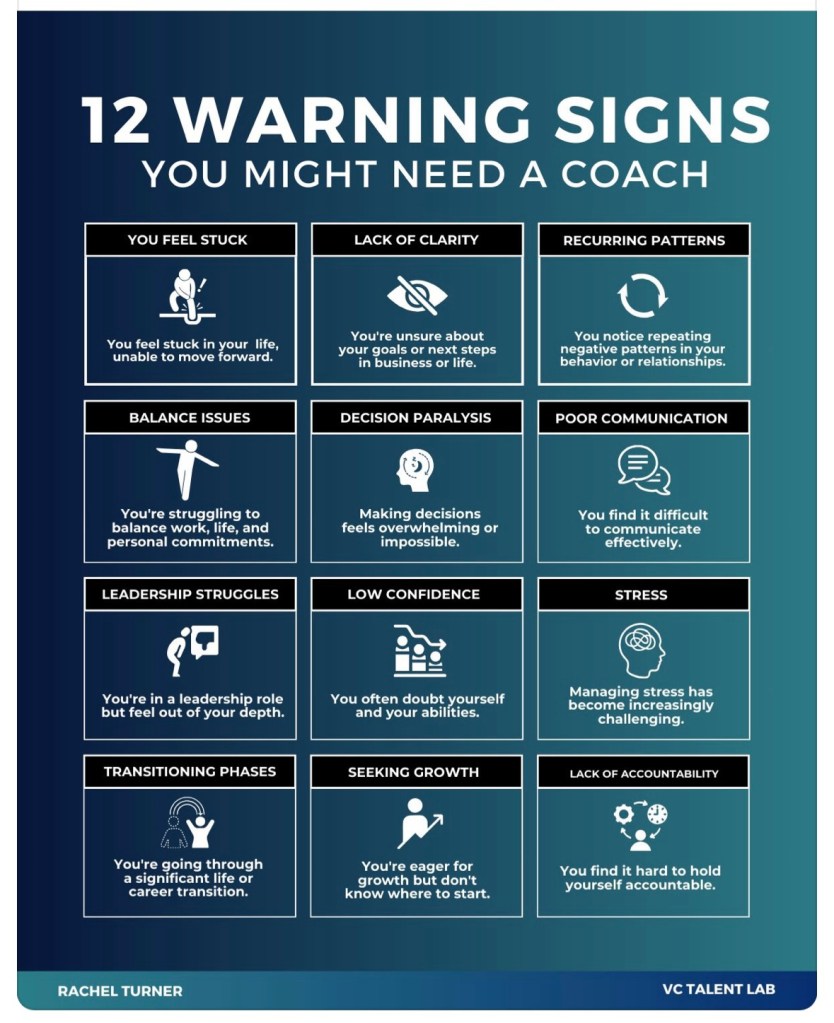
12 Warning Signs You Might Need A Coach

The 12 warning signs you might need a coach a stellar Rachel Turner share. A list you would be mad to miss:

  1. You feel stuck.
    You feel stuck in your personal or professional life, unable to move forward.
  2. Lack of clarity.
    You’re unsure about your goals or next steps in life.
  3. Recurring negative patterns. 
    You notice repeating negative patterns in your behavior or relationships.
  4. Balance issues.
    You’re struggling to balance work, life, and personal commitments.
  5. Decision paralysis.
    Making decisions feels overwhelming or impossible.
  6. Low confidence.
    You often doubt yourself and your abilities.
  7. Communication challenges.
    You find it difficult to communicate effectively in personal or professional settings.
  8. Leadership struggles.
    You’re in a leadership role but feel out of your depth.
  9. Chronic stress.
    Managing stress has become increasingly challenging.
  10. Transitioning phases.
    You’re going through a significant life or career transition.
  11. Seeking growth.
    You’re eager for personal or professional growth but don’t know where to start.
  12. Lack of accountability.
    You find it hard to hold yourself accountable.

Here’s what a coach can do:

✨ Provide clarity in your chaos.
✨ Offer unbiased feedback.
✨ Help you identify and break negative patterns.
✨ Guide you through life’s transitions.
✨ Boost your decision-making skills.
✨ Elevate your leadership abilities.

Because sometimes, the only thing standing between you and your goals is you.

11 Things You Must Delete From Your Life In Silent

Coaching Gift Of Personal Growth

Ditch It: Professional Career Exit Plan

  • 6-8 Coaching Sessions
  • Goal Setting
  • Networking & Building Relationships
  • Skill & Knowledge Gap Analysis

In With the New: For The Newly Promoted Supervisor

  • 6-12 Personalized Leadership Sessions
  • Build Relationship
  • Address Workplace Challenges
  • Enhance Team Dynamics
  • Setting Goals
  • Leadership Development Support

Write that Book Aspiring Authors

  • 6-12 Sessions
  • The Writing & Publishing Process
  • Get it Done

🎁 WHY CHOOSE US: 🌟 Certified Master Coaches 📈 Proven track record 🤝 Tailored approach

Gift Coaching Certificate

Choosing any of these coaching programs will make a fantastic gift this holiday season and throughout the year. It’s the gift of personal Growth that lasts.

Need more information? Let’s connect

5 Points To Consider When Transitioning Into A New Career

I Chose Me Yet I Felt Guilty …

I chose me. Yet I felt guilty.

I chose me and I felt guilty. Hmm, has that ever happened to you? I chose the best option for me given the situation, yet I felt so guilty. I’m a giver. Everybody knows that. I give of my time and energy to others, most often sacrificially. I had two obligations simultaneously while making funeral plans for a close relative. Balancing all three events was hard. Funeral arrangements take you on an emotional roller coaster. Just imagine the ride.

After much thought and careful consideration, I chose the conference that would contribute to my own personal growth and development. It solidified by decision to try new things. Yet I felt guilty about the one I omitted which would have benefited others and not me.

Has that ever happened to you? The art of self-care is important. It forges balance and one that’s definitely needed especially during busy times. Here are 9 ways to help you take care of you combined with these those listed:

  • Stand up for yourself
  • Don’t respond to a call/email (that will stress you) until you’re ready
  • Put yourself first (not selfishly)
  • Miss a social event
  • Be less perfect
  • Say no
  • End a toxic relationship
  • Take breaks (it works wonders)
  • Set boundaries
  • Ask for your needs to be met (within reason)

Hope this list created by @insightful and shared by Viola Davis will help you maintain the care you need to give to yourself and boost your momentum.

Cheers!

Not Perfect But…

Don’t be afraid to try

Not perfect but still doing it. Dr. Charles Stanley said it.

Pastor Steven furtick said it about being in his youth and starting a new church with his wife.

Reggae Music Miss Pat Chin said it too. She said when she started entrepreneurship she didn’t know what she was doing. Young. Niaive but she tried big things not realizing they were too big for a new entrepreneur.

Guess what? It worked! Because she didn’t know. She tried, did it and yep success!

Dr Suess’s idea was different. Novel. Untried by others so his manuscript was rejected by many publishers. Then he met a friend who had just received a promotion to of all things… a publisher! The right place. The right time. The dots connected. Today Dr Seuss is a household name worldwide.

So don’t be afraid to try new crazy things! Things untried by others …because … it just might work.

Cheers!

Navigating Your Career Transition Over The Holidays…

The holidays aren’t just for celebrations; they’re a golden opportunity to unwrap your career’s potential! -✨

Join us for the ‘Navigating Your Career Transition During the Holidays’ seminar, where you’ll discover how to embark on your career journey with renewed energy and clarity. Don’t wait for the new year—start building your dream career now.

📍 Where: Watch online

What You’ll Gain: –

  • Key strategies to seamlessly transition into your dream career.
  • Goal-setting techniques to kickstart the new year with purpose.
  • Insights from experienced career transition experts.
  • Tips to make the most of the holiday season while propelling your career forward.
  • Building Your Personal Brand for Success

Let the holiday season be the launchpad for your career transformation. Don’t miss this chance to make a significant leap in your professional life.

Secure your spot now and embrace a brighter, more promising career future!

9+ Ways To Defeat Procrastination

You cannot escape the responsibility of tomorrow by evading it today.

Abraham Lincoln

A colleague shared her exhaustion with what she termed as her habitual procrastination. She was tired of incomplete tasks in her life and asked for help.

Avoiding procrastination is essential for leaders and professionals to maintain productivity and achieve goals. Here are 9+ key points shared to help overcome this practice.

1.Self-Awareness

Recognize your procrastination habits and understand the underlying causes. Self-awareness is the first step to change.

2.Prioritization

Prioritizing tasks is essential. Leaders should focus on high-impact, high-priority activities first.

3.Set Clear Goals

Set specific, measurable, achievable, relevant, and time-bound (SMART) goals. Having clear objectives provides motivation and direction.

4.Time Management

Use effective time management techniques, such as time blocking, to help you allocate your time efficiently.

5. Break Tasks into Smaller Steps

Practice breaking larger tasks into smaller, manageable steps. This makes tasks less daunting and more achievable.

6.Delegation

Trust more. Delegate tasks to capable team members when possible. Delegation frees up time for strategic thinking and higher-priority activities.

7. Overcoming Perfectionism

Are you a perfectionist? Often this tendency fuels procrastination through delaying completing projects until they are perfect. Focus on progress, not perfection.

8. Accountability

Set up an accountability system, such as working with a mentor, coach, or a peer who can hold you responsible for deadlines and commitments.

9. Eliminate Distractions

Identify strategies to minimize distractions, whether it’s turning off notifications, setting specific work hours, or creating a clutter-free workspace.

10. Self-Motivation

Identify your intrinsic motivation. What drives them to succeed? Connecting with their personal “why” can provide the push you need.

11. Time for Self-Care

Practice taking regular breaks and prioritize self-care. A well-rested and healthy leader is less likely to procrastinate.

12. Mindfulness and Focus

Adopt mindfulness practices and techniques that can improve focus and attention, reducing the temptation to procrastinate.

13. Positive Self-Talk

Replace negative self-talk with positive affirmations. Confidence can help combat procrastination.

14. Celebrate Achievements

Acknowledge and celebrate your accomplishments, no matter how small. Positive reinforcement can reinforce productivity.

15. Continuous Improvement

Focus on the concept of continuous improvement. As a Leader, it is important to regularly assess your time management and productivity strategies and adjust as needed.

16. Seek Professional Support

If procrastination is chronic and significantly hinders your leadership effectiveness, seek support from a therapist or counselor who specializes in procrastination or time management issues.

As a certified Master leadership coach, I provide support, guidance, and accountability to leaders to help them work to overcome procrastination. Implementing the strategies articulated here and developing healthy habits will lead to more effective and efficient leadership.

Need help, lets connect today.

Cheers!

Coaching: Come Messy. Leave Happy….

Doubt increases with inaction. Clarity reveals itself in momentum. Growth comes from progress. For all these reasons, BEGIN.

Brendon Burchard

My niece is a celebrity makeup artist. She has done many. When they come to see her, they come just as they are–plain, messy, but ready to rock. Together they work on their goals. What’s the problem? What’s the occasion (wedding, birthday celebration, rebranding)? What’s the purpose (new business, product, new album, video)? They then work together to make their goals beautiful.

Same with the healing power. The sick goes to the doctor to be healed. They’re not well. They try home remedies and nothing works. But pretty soon they come to the realization that they need help.

Coaching is just like that. Come messy. Come stuck. come with your frustrations, your limitations, procrastinations. We work together to identify goals, explore possibilities, get clarity, strategize follow through and make dreams come through.

COACHING: THE CONTEXT

Coaching is one of the most powerful tools because it acts as a catalyst. Coaching gives our clients the right motivation to take actions that make them successful. As coaches we provide inspiration, motivation, and encouragement to help our clients attain their goals. We seek to discover and understand context and help clients define key areas of leadership development that will lead to transformational outcomes.

That’s what we do. Let’s connect. Come messy, leave happy.

Have you ever experienced coaching? What was the outcome? Do share, we would love to hear.

Cheers!

6+ Tips To Optimize Your LinkedIn Profile for a Midlife Career Change…

Change is the law of life. And those who look only to the past or present are certain to miss the future.

John F. Kennedy

Thinking of a change in your career? LinkedIn is rated as the world’s largest professional network. You can use it to connect and strengthen professional relationships, find jobs, and more.

Chances are you already have a profile but when was the last time you looked at it? Hmmm…

Here are 6 tips to optimize your profile for leaders and professionals who wish to make a change so you can become more visible to Executives, headhunters and Recruiters.

1.Relevant Headline and Summary: Craft a headline that reflects your desire to transition into a new field and a summary that emphasizes your transferable skills and passion for the new industry.

2.Professional Photo: Update your profile picture to present a polished and adaptable appearance that aligns with your desired career change.

3. Keyword Optimization: Use keywords associated with the new field you’re targeting, showcasing your intention to pivot and ensuring your profile appears in relevant searches.

4. Experience Section: Highlight experiences, projects, or accomplishments that align with the skills required in your target industry, even if they were gained from previous roles.

5. Recommendations: Obtain recommendations from colleagues or supervisors who can speak to your adaptability, quick learning, and positive attitude.

6. Content Sharing: Share insightful content related to your intended field, showcasing your genuine interest and commitment to learning about the industry.

7. Networking: Connect with professionals in your desired field to expand your network and gain insights into the industry’s nuances and trends.

8. Training and Certifications: Highlight any relevant courses, workshops, or certifications you’ve completed to bolster your qualifications for the new career path.

9. Volunteer Work and Side Projects: Include any volunteer experiences or side projects that demonstrate your dedication to learning and contributing to the new field.

10. Custom URL: Personalize your LinkedIn profile URL and showcase your enthusiasm for the career change.

Remember, authenticity and consistency are key to building a compelling LinkedIn profile that accurately represents your goals and aspirations. Get going and update your profile now. Need help? Lets connect

Which tip stood out to you? Do share, we would love to hear.

Cheers!

Don’t forget to Share this with a friend.

Travel with Intent

A photographer's view of the world - words and images to inspire your travels and your dreams

Answering daily prompts

In this blog I'm attempting to answer wordpress daily prompts

Alex Tafur

Property Maintenance

Poesy Perspectives

embrace the magic

GREENLiGHT

When God Says Go

HEALTH | INSPIRATION

Mind • Body • Life

My Sister My Friend

Family. Youth. Parenting

Kamileon Photography

Your Focus. Our Lens.