By the age of twenty, you know you’re not going to be a rock star. By twenty-five, you know you’re not going to be a dentist or any kind of professional. And by thirty, darkness starts moving in- you wonder if you’re ever going to be fulfilled, let alone wealthy and successful. By thirty-five, you know, basically, what you’re going to be doing for the rest of your life, and you become resigned to your fate…
Doug Couplan
Anthony felt like Doug’s quote when he cried out for help. It seems like doomsday to him. We began chatting with the goal to put some things in place because all is not lost.
For those turning age 30 and feel alone as if they’re fighting to achieve their dreams, this is the stage where you should be self-reflecting, skill evaluating, engaging in healthy habits and networking. Here each point is explained.
Self-Reflection:
Reflect on your achievements and experiences so far.
Identify personal and professional goals for the next decade.
Skill Enhancement:
Assess your skillset and consider acquiring new skills.
Explore educational opportunities or certifications that align with your career goals.
Healthy Habits:
Establish and prioritize healthy lifestyle habits.
Focus on physical and mental well-being to set a foundation for the future.
Networking:
Build and strengthen professional networks.
Seek mentorship and guidance from experienced individuals in your field.
Are you age 30 and experiencing any of these signs? You may also have already turned 30 and have lots to share about your journey. Do share. We would love to hear.
Don’t get distracted. Never tell yourself that you need to be the biggest brand in the whole world. Start by working on what you need at the present moment and then what you need to do tomorrow. So, set yourself manageable targets.
Jas Bagniewski
20% of new startups fail within the first year of business. This can be scary for first time entrepreneurs. So, the more prepared small businesses are, the more they can survive especially as it concerns making bold marketing steps which require some upfront investment. That said, here are some ideas to counteract those costs for a new business owner on a tight budget:
Leverage free platforms – For example, start a free blog, post on LinkedIn, use free webinar services, publish a podcast using free hosting.
2. Barter services – Exchange things like hosting an event or providing content in return for exposure from partnerships.
3.Get sponsorships – Seek sponsorships from vendors/partners to help fund events, ads, giveaways. Offer sponsor visibility.
4. Use DIY options – Design your own simple website, create your own flyers, give free talks at local libraries versus paid venues.
5. Offer packages – Offer bundles and multi-session discounts to incentive larger purchases to increase revenue.
6.Be guest instead of host – Guest blog, speak at other events instead of funding your own. Reduces costs.
7. Tap into your network– Ask connections to share content, provide referrals, submit testimonials, write guest posts.
8. Focus locally first – Start by promoting heavily just within your local community to establish proof of concept.
9. Only invest where needed – Don’t overspend on unnecessary items. Prioritize money only where it will derive direct value.
Essentially, the goal is to maximize existing free resources and opportunities where you can exchange services. The aim is to become creative in order to access cost-effective resources until you gain proof of return on investment, then you can increase spending.
Which of the methods have you used? Can you add another method that has proven helpful? Do share. We would love to hear.
Natalie, a frustrated high school graduate, had been in and out of jobs for four years after graduating high school. She was referred for coaching because she was annoyed at the way employers treated her and she refused to accept it. The lack of income did not help as she needed to meet her needs.
This situation is common among young adults who are in the early stages of their career and ‘waiting’ for their ideal job (and yessss among others with years of experience too). The 15 Strategies listed can be adapted to secure employment, gain valuable experience and bring you closer to your ideal career.
Career Goals: 15 Steps To Success
1. Apply For Entry-Level Positions
Target entry-level positions in your field of interest.
Look for internships, apprenticeships, or part-time positions to gain hands-on experience.
2. Enhance Your Resume
Highlight relevant skills, coursework, and any extracurricular activities.
Tailor your resume for each application to match the specific job requirements.
3. Networking
Attend industry events, workshops, and networking mixers.
Connect with professionals on LinkedIn and engage in conversations.
4. Online Job Platforms
Explore job search platforms like LinkedIn, Indeed, Glassdoor, and company websites.
Set up job alerts to receive notifications for relevant positions.
5. Temporary Work or Freelancing
Consider taking temporary positions or freelancing opportunities to build your skills and network.
Platforms like Upwork or Fiverr can be good for freelancing gigs.
6. Professional Development
Take online courses or certifications to enhance your skills.
Mention ongoing learning initiatives on your resume to showcase your commitment to personal and professional development.
7. Volunteer Work
Offer your time to non-profit organizations or community projects.
Volunteering can provide valuable experience and demonstrate your dedication.
8. Informational Interviews
Reach out to professionals in your field for informational interviews.
Gather insights, seek advice, and express your eagerness to learn from their experiences.
9. Create Online Portfolio
Build an online portfolio showcasing your projects, coursework, or any freelance work.
Include a link to your portfolio on your resume and LinkedIn profile
10. Skill Development
Identify skills in demand within your industry and work on acquiring them.
Online platforms like Coursera, Udemy, or Skillshare offer a variety of courses.
11. Professional Social Media Presence
Ensure your LinkedIn profile is complete and professional.
Share relevant content and engage with professionals in your field.
12. Industry Research
Stay informed about trends and changes in your desired industry.
Use this knowledge to tailor your applications and interviews.
13. Career Counseling Services
Seek guidance from career counseling services offered by educational institutions or career centers.
They can provide insights into job opportunities and help you refine your career goals.
14. Participate in Job Fairs
Attend job fairs, both virtual and in-person, to connect with employers and explore potential opportunities.
15. Soft Skills Development
Work on developing essential soft skills such as communication, teamwork, and adaptability.
These skills are often highly valued by employers.
Remember, the job search process can take time, and being open to various opportunities can lead to unexpected but valuable experiences. Stay persistent, connect with a coach, maintain a positive attitude, and continuously refine your approach based on feedback and experiences.
Joy was excited about launching her business and she did! Now six months later, she has been finding it difficult to survive financially. With rising debt and living expenses, she is unable to make ends meet. She reached out for coaching to tackle her inner stress while pondering if she had made a mistake.
This situation is common to many first-time entrepreneurs. Statistics show that many small businesses fail during the first year. Most ponder giving up or staying the course. The decision between working on their new business or getting a job often depends on various factors. Here are a few:
Financial Stability: If an entrepreneur’s financial situation is precarious and their business isn’t generating immediate income, getting a job might be necessary to cover living expenses and support the business financially.
Business Stage: Early-stage businesses might require time and effort before becoming profitable. In such cases, working on the business while having a part-time job or a source of stable income could be a feasible option.
Learning Curve: New entrepreneurs might benefit from working in the industry they’re entering. A job can offer insights, experience, and networking opportunities that can be invaluable for their business.
Time Commitment: Running a business demands a significant time commitment. If the business requires full-time attention to get off the ground, working solely on the business might be necessary initially.
Risk Tolerance: Some entrepreneurs prefer to dedicate all their time and energy to their business, even if it means financial strain initially, while others might opt for a more gradual approach to reduce financial risk.
In many cases, a hybrid approach—working part-time or freelancing while gradually growing the business—can strike a balance between financial stability and business development. It allows entrepreneurs to sustain themselves while dedicating time to their entrepreneurial venture.
Ultimately, it’s crucial to assess individual circumstances, weigh the pros and cons, and make a decision that aligns with both the financial needs and the growth potential of the business.
Are you a new entrepreneur experiencing first year growth pains? Which of the above will you adopt and apply to your situation? Are there any others that you have considered? Do share. We would love to hear.
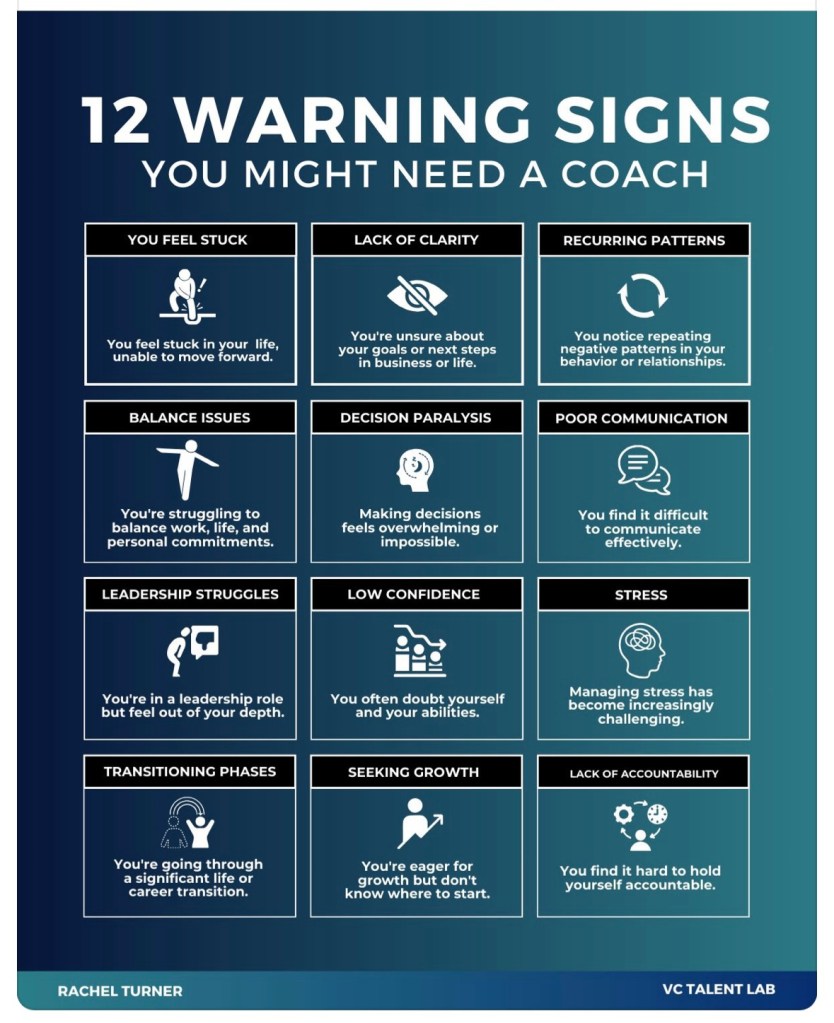
The 12 warning signs you might need a coach a stellar Rachel Turner share. A list you would be mad to miss:
You feel stuck. You feel stuck in your personal or professional life, unable to move forward.
Lack of clarity. You’re unsure about your goals or next steps in life.
Recurring negative patterns. You notice repeating negative patterns in your behavior or relationships.
Balance issues. You’re struggling to balance work, life, and personal commitments.
Decision paralysis. Making decisions feels overwhelming or impossible.
Low confidence. You often doubt yourself and your abilities.
Communication challenges. You find it difficult to communicate effectively in personal or professional settings.
Leadership struggles. You’re in a leadership role but feel out of your depth.
Chronic stress. Managing stress has become increasingly challenging.
Transitioning phases. You’re going through a significant life or career transition.
Seeking growth. You’re eager for personal or professional growth but don’t know where to start.
Lack of accountability. You find it hard to hold yourself accountable.
Here’s what a coach can do:
✨ Provide clarity in your chaos. ✨ Offer unbiased feedback. ✨ Help you identify and break negative patterns. ✨ Guide you through life’s transitions. ✨ Boost your decision-making skills. ✨ Elevate your leadership abilities.
Because sometimes, the only thing standing between you and your goals is you.
Choosing any of these coaching programs will make a fantastic gift this holiday season and throughout the year. It’s the gift of personal Growth that lasts.
I chose me and I felt guilty. Hmm, has that ever happened to you? I chose the best option for me given the situation, yet I felt so guilty. I’m a giver. Everybody knows that. I give of my time and energy to others, most often sacrificially. I had two obligations simultaneously while making funeral plans for a close relative. Balancing all three events was hard. Funeral arrangements take you on an emotional roller coaster. Just imagine the ride.
After much thought and careful consideration, I chose the conference that would contribute to my own personal growth and development. It solidified by decision to try new things. Yet I felt guilty about the one I omitted which would have benefited others and not me.
Has that ever happened to you? The art of self-care is important. It forges balance and one that’s definitely needed especially during busy times. Here are 9 ways to help you take care of you combined with these those listed:
Stand up for yourself
Don’t respond to a call/email (that will stress you) until you’re ready
Not perfect but still doing it. Dr. Charles Stanley said it.
Pastor Steven furtick said it about being in his youth and starting a new church with his wife.
Reggae Music Miss Pat Chin said it too. She said when she started entrepreneurship she didn’t know what she was doing. Young. Niaive but she tried big things not realizing they were too big for a new entrepreneur.
Guess what? It worked! Because she didn’t know. She tried, did it and yep success!
Dr Suess’s idea was different. Novel. Untried by others so his manuscript was rejected by many publishers. Then he met a friend who had just received a promotion to of all things… a publisher! The right place. The right time. The dots connected. Today Dr Seuss is a household name worldwide.
So don’t be afraid to try new crazy things! Things untried by others …because … it just might work.
The holidays aren’t just for celebrations; they’re a golden opportunity to unwrap your career’s potential! -✨
Join us for the ‘Navigating Your Career Transition During the Holidays’ seminar, where you’ll discover how to embark on your career journey with renewed energy and clarity. Don’t wait for the new year—start building your dream career now.
You cannot escape the responsibility of tomorrow by evading it today.
Abraham Lincoln
A colleague shared her exhaustion with what she termed as her habitual procrastination. She was tired of incomplete tasks in her life and asked for help.
Avoiding procrastination is essential for leaders and professionals to maintain productivity and achieve goals. Here are 9+ key points shared to help overcome this practice.
1.Self-Awareness
Recognize your procrastination habits and understand the underlying causes. Self-awareness is the first step to change.
2.Prioritization
Prioritizing tasks is essential. Leaders should focus on high-impact, high-priority activities first.
3.Set Clear Goals
Set specific, measurable, achievable, relevant, and time-bound (SMART) goals. Having clear objectives provides motivation and direction.
4.Time Management
Use effective time management techniques, such as time blocking, to help you allocate your time efficiently.
5. Break Tasks into Smaller Steps
Practice breaking larger tasks into smaller, manageable steps. This makes tasks less daunting and more achievable.
6.Delegation
Trust more. Delegate tasks to capable team members when possible. Delegation frees up time for strategic thinking and higher-priority activities.
7. Overcoming Perfectionism
Are you a perfectionist? Often this tendency fuels procrastination through delaying completing projects until they are perfect. Focus on progress, not perfection.
8. Accountability
Set up an accountability system, such as working with a mentor, coach, or a peer who can hold you responsible for deadlines and commitments.
9. Eliminate Distractions
Identify strategies to minimize distractions, whether it’s turning off notifications, setting specific work hours, or creating a clutter-free workspace.
10. Self-Motivation
Identify your intrinsic motivation. What drives them to succeed? Connecting with their personal “why” can provide the push you need.
11. Time for Self-Care
Practice taking regular breaks and prioritize self-care. A well-rested and healthy leader is less likely to procrastinate.
12. Mindfulness and Focus
Adopt mindfulness practices and techniques that can improve focus and attention, reducing the temptation to procrastinate.
13. Positive Self-Talk
Replace negative self-talk with positive affirmations. Confidence can help combat procrastination.
14. Celebrate Achievements
Acknowledge and celebrate your accomplishments, no matter how small. Positive reinforcement can reinforce productivity.
15. Continuous Improvement
Focus on the concept of continuous improvement. As a Leader, it is important to regularly assess your time management and productivity strategies and adjust as needed.
16. Seek Professional Support
If procrastination is chronic and significantly hinders your leadership effectiveness, seek support from a therapist or counselor who specializes in procrastination or time management issues.
As a certified Master leadership coach, I provide support, guidance, and accountability to leaders to help them work to overcome procrastination. Implementing the strategies articulated here and developing healthy habits will lead to more effective and efficient leadership.