A extraordinary leader, Martin Luther King, Jr., was a Baptist minister. His death catapulted a movement so others could live. Many national heroes and legendary leaders have made an impact through their deaths. Their deaths helped others live. It causes us to wonder if some people are born with the purpose of making a difference after death.
The concept of long life is not summed up in years but by the quality of how those years are spent. The impact we have on those we love and others. The difference we make in life.
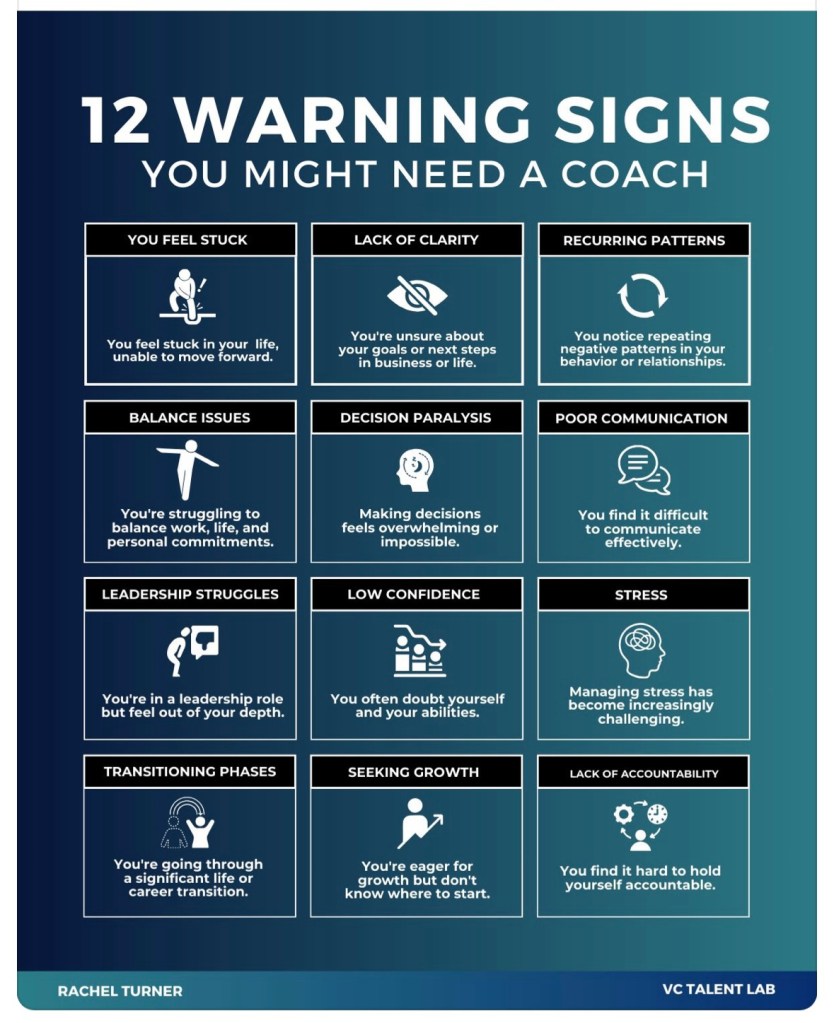
The 12 warning signs you might need a coach a stellar Rachel Turner share. A list you would be mad to miss:
You feel stuck. You feel stuck in your personal or professional life, unable to move forward.
Lack of clarity. You’re unsure about your goals or next steps in life.
Recurring negative patterns. You notice repeating negative patterns in your behavior or relationships.
Balance issues. You’re struggling to balance work, life, and personal commitments.
Decision paralysis. Making decisions feels overwhelming or impossible.
Low confidence. You often doubt yourself and your abilities.
Communication challenges. You find it difficult to communicate effectively in personal or professional settings.
Leadership struggles. You’re in a leadership role but feel out of your depth.
Chronic stress. Managing stress has become increasingly challenging.
Transitioning phases. You’re going through a significant life or career transition.
Seeking growth. You’re eager for personal or professional growth but don’t know where to start.
Lack of accountability. You find it hard to hold yourself accountable.
Here’s what a coach can do:
✨ Provide clarity in your chaos. ✨ Offer unbiased feedback. ✨ Help you identify and break negative patterns. ✨ Guide you through life’s transitions. ✨ Boost your decision-making skills. ✨ Elevate your leadership abilities.
Because sometimes, the only thing standing between you and your goals is you.
As a leadership coach who has help many transition their careers in business and entrepreneurship, I was curious when I came across MSN’s Andrew Herring’s story on careers that will disappear in the next decade. Here I share.
Is Your Job On The List?
Drivers. Not sure if I am ready to be driven around by driverless cars, but ready or not, it’s coming.
Customer Service Reps were the ones we couldn’t live without. These days we have to since we cannot get a ‘human‘ on the phone. Besides, who wants to speak with anyone anyways in this text era?
Factory workers. No surprise here considering automation.
Travel Agents. They are more travel smart but airlines direct sales to our emails, we keep forgetting their value.
Bank Tellers. Can’t recall the last time I went into a bank line. Drive through, online check negotiations and direct deposits from employers, this is believable.
Proofreaders. I still like this especially as an author but lots of software available, so this is not so far-fetched.
Receptionists. Wonder who will I see when I walk into brick-and-mortar businesses? Hotel check-ins, direct to agent services, I guess?
Bookkeepers. Who uses them anyway when Ai keeps track and easily track expenses, reconcile and fast generate reports?
Data EntryClerks. Check what your phone scan feature can do. Yep, it can easily read handwriting and convert it into digital text. Absolutely convenient.
Telemarketers. I think my 91-year-old uncle will miss answering the phone angrily. It seems the calls never stop these days.
So, there you have it. Ensure that the job of your dreams still exists before you invest in it. Otherwise, are there any jobs missing from the list? Or should any be removed? Please share. We would love to hear!
Janet was elated when she was promoted for her exceptional skills and expertise in performing her job. Within a few weeks she called expressing her frustration as she felt like an imposter. She was finding it difficult to handle the challenges of her new role.
Challenges and Problems New Supervisors Face
Here are some common problems and challenges new supervisors often face:
Lack Authority -Promoted but struggle to influence former peers.
Ineffective Delegation – New supervisors may want to prove themselves by doing it all without delegating. End up micromanaging or miss opportunities to empower their team.
Poor Time Management – Often end up buried in daily tasks compromising productivity.
Mishandling Performance – avoid difficult conversation or acting too aggressively to assert authority.
Poor Communication skills -Giving direction or feedback is unclear, not listening or making assumptions.
Maintaining friendships – Boundaries blur as new supervisors must now manage former co-workers who were friends.
Lack of leadership training – often promoted without receiving adequate training.
Unrealistic expectations – new supervisors may feel they know everything already or may want to quick-fix long standing issues quickly.
Imposter syndrome – doubt their abilities, lack confidence, or feel underqualified.
Stress and work/life balance – they become overwhelmed by the pressures of the responsibilities of the new role.
Go it Alone – Does not seek help from a coach who can help them navigate the new role.
With proper mentoring, training, and experience over time, these common pitfalls can be overcome. Patience, self-awareness, and a learning mindset are key for successfully transitioning to supervisor.
Connect with a leadership coach who will help you confidentially maneuver the challenges of your new role.
Questions or need to add any missing challenge? Do share, we would be glad to hear.
Give the gift of insight, inspiration, and growth this holiday season! Delve into the world of leadership, self-discovery, inspiration and professional development with these curated books. Perfect for friends, family, or colleagues seeking to elevate their leadership skills and embark on a transformative journey. Click the Gift Guide, choose a book that sparks growth and ignites the potential within your loved ones this festive season!
Each Book link takes you directly to Amazon where you can buy, beautifully gift wrap and place under your well-lit sparkling Christmas tree. Voila! They’re thrilled!
Hope this guide has inspired your gift giving. E-books are perfect for last minute book shoppers. Grab copies for the perfect New Year’s gift. Oh, don’t forget to get a copy of my just released book RedLight: When God Says No which completes the GreenLight trilogy.
I chose me and I felt guilty. Hmm, has that ever happened to you? I chose the best option for me given the situation, yet I felt so guilty. I’m a giver. Everybody knows that. I give of my time and energy to others, most often sacrificially. I had two obligations simultaneously while making funeral plans for a close relative. Balancing all three events was hard. Funeral arrangements take you on an emotional roller coaster. Just imagine the ride.
After much thought and careful consideration, I chose the conference that would contribute to my own personal growth and development. It solidified by decision to try new things. Yet I felt guilty about the one I omitted which would have benefited others and not me.
Has that ever happened to you? The art of self-care is important. It forges balance and one that’s definitely needed especially during busy times. Here are 9 ways to help you take care of you combined with these those listed:
Stand up for yourself
Don’t respond to a call/email (that will stress you) until you’re ready
Not perfect but still doing it. Dr. Charles Stanley said it.
Pastor Steven furtick said it about being in his youth and starting a new church with his wife.
Reggae Music Miss Pat Chin said it too. She said when she started entrepreneurship she didn’t know what she was doing. Young. Niaive but she tried big things not realizing they were too big for a new entrepreneur.
Guess what? It worked! Because she didn’t know. She tried, did it and yep success!
Dr Suess’s idea was different. Novel. Untried by others so his manuscript was rejected by many publishers. Then he met a friend who had just received a promotion to of all things… a publisher! The right place. The right time. The dots connected. Today Dr Seuss is a household name worldwide.
So don’t be afraid to try new crazy things! Things untried by others …because … it just might work.
You cannot escape the responsibility of tomorrow by evading it today.
Abraham Lincoln
A colleague shared her exhaustion with what she termed as her habitual procrastination. She was tired of incomplete tasks in her life and asked for help.
Avoiding procrastination is essential for leaders and professionals to maintain productivity and achieve goals. Here are 9+ key points shared to help overcome this practice.
1.Self-Awareness
Recognize your procrastination habits and understand the underlying causes. Self-awareness is the first step to change.
2.Prioritization
Prioritizing tasks is essential. Leaders should focus on high-impact, high-priority activities first.
3.Set Clear Goals
Set specific, measurable, achievable, relevant, and time-bound (SMART) goals. Having clear objectives provides motivation and direction.
4.Time Management
Use effective time management techniques, such as time blocking, to help you allocate your time efficiently.
5. Break Tasks into Smaller Steps
Practice breaking larger tasks into smaller, manageable steps. This makes tasks less daunting and more achievable.
6.Delegation
Trust more. Delegate tasks to capable team members when possible. Delegation frees up time for strategic thinking and higher-priority activities.
7. Overcoming Perfectionism
Are you a perfectionist? Often this tendency fuels procrastination through delaying completing projects until they are perfect. Focus on progress, not perfection.
8. Accountability
Set up an accountability system, such as working with a mentor, coach, or a peer who can hold you responsible for deadlines and commitments.
9. Eliminate Distractions
Identify strategies to minimize distractions, whether it’s turning off notifications, setting specific work hours, or creating a clutter-free workspace.
10. Self-Motivation
Identify your intrinsic motivation. What drives them to succeed? Connecting with their personal “why” can provide the push you need.
11. Time for Self-Care
Practice taking regular breaks and prioritize self-care. A well-rested and healthy leader is less likely to procrastinate.
12. Mindfulness and Focus
Adopt mindfulness practices and techniques that can improve focus and attention, reducing the temptation to procrastinate.
13. Positive Self-Talk
Replace negative self-talk with positive affirmations. Confidence can help combat procrastination.
14. Celebrate Achievements
Acknowledge and celebrate your accomplishments, no matter how small. Positive reinforcement can reinforce productivity.
15. Continuous Improvement
Focus on the concept of continuous improvement. As a Leader, it is important to regularly assess your time management and productivity strategies and adjust as needed.
16. Seek Professional Support
If procrastination is chronic and significantly hinders your leadership effectiveness, seek support from a therapist or counselor who specializes in procrastination or time management issues.
As a certified Master leadership coach, I provide support, guidance, and accountability to leaders to help them work to overcome procrastination. Implementing the strategies articulated here and developing healthy habits will lead to more effective and efficient leadership.
A good coach can change a game. A great coach can change a life.
John Wooden
She ran to the restroom and screamed. Sabrina had a job to do, and her manager knew she could do it well, but she kept questioning her over the past six months. As the year-end drew near, the project was near due. But the constant checking in was more of a time waster than productive. Sabrina became frustrated. How could she tell her manager to allow her to focus?
Coaching employees on career development without resorting to micromanagement requires a delicate balance of support, guidance, and autonomy. As a leadership coach, I recommend employing a coaching approach that fosters individual growth and self-driven progress is important. Here’s a brief summary of 10 tips on how to approach this:
Establish Trusting Relationships: The foundation of effective coaching is trust. Build strong, open, and honest relationships with employees, creating a safe space for them to share their career aspirations, concerns, and challenges.
Active Listening: Actively listen to employees, understand their goals, strengths, and areas for improvement. By attentively hearing their needs, supervisors can tailor coaching discussions to their unique career paths.
Goal Setting: Together with employees, collaboratively set clear, SMART (Specific, Measurable, Achievable, Relevant, Time-bound) goals. This ensures that their career objectives are well-defined and realistic.
Empower and Encourage: Instead of micromanaging, empower employees to take ownership of their career development. Encourage them to seek out opportunities, challenge themselves, and take initiative in their professional growth.
Provide Resources: Offer guidance on available resources, such as training programs, workshops, or mentorship opportunities, that can aid employees in acquiring new skills and knowledge aligned with their career goals.
Feedback and Reflection: Promote a culture of continuous feedback and reflection. By offering constructive feedback and encouraging employees to assess their progress, they become more self-aware and adaptable.
Accountability: Employees are encouraged to hold themselves accountable for their career development. As a leadership coach, it is recommended that supervisors help employees establish milestones and regularly check in on their progress without micromanaging their day-to-day tasks.
Supportive Coaching: Through regular coaching sessions, provide a supportive framework where employees can discuss challenges, seek guidance, and refine their strategies for career advancement.
Celebrate Achievements: Recognizing and celebrating milestones and achievements is crucial for motivation. Acknowledge employees’ accomplishments, reinforcing their sense of progress and satisfaction.
Adaptability: Recognize that career paths may evolve, be flexible and adapt coaching strategies to align with changing goals and circumstances.
By coaching employees in this manner, we can empower them to take control of their career development journey. It fosters a sense of autonomy, motivation, and engagement while avoiding the pitfalls of micromanagement. Ultimately, the goal is to help individuals thrive and achieve their career aspirations in a supportive and non-intrusive manner.
Be exposed to exclusive insights from accomplished beauty pageant contestants who have mastered the art of goal-setting and achieving remarkable success.
In this captivating video, you will be exposed to exclusive insights from accomplished beauty pageant contestants who have mastered the art of goal-setting and achieving remarkable success.
Listen in as Miss Universe Trinidad & Tobago Dalise Lockhart and Miss New England Petite, Kimberly Campbell share their personal journeys, strategies, and invaluable wisdom on setting and reaching your aspirations.
Discover the secrets to turning dreams into reality
Overcoming obstacles
Staying motivated on your path to success.
Whether you’re striving for success in pageantry, your career, or life in general, these beauty queens’ experiences and expertise will provide you with practical tips and inspiration to help you unlock your full potential.
Don’t miss out on this empowering conversation with some of the most accomplished individuals in the world of beauty pageants. Share with your friends who are on their journey to achieving greatness. Get ready to ignite your passion, set ambitious goals, and embark on a journey to success. Lean in and listen and let’s begin this exciting adventure together!