Failure: The Final Frontier…

img_1561

Failure, is it the Final frontier? Oprah Winfrey learned that failure is only an illusion after her cable network started off poorly. She said the worst time in her professional life came when the Oprah Winfrey Network’s (OWN) ratings plummeted a year after launch. Later, in a Harvard commencement speech, Winfrey said that she told herself repeatedly that failure is an illusion. She said “there is no such thing as failure. Failure is just a lie trying to move us in another direction.

Brian Tracy asked the question “What is the best advice you have ever received for overcoming your fear of failure?” Responders shared:

  • Don’t hate your weaknesses, God will meet you there!
  • You will never experience true success without learning from some level of failure
  • No matter how slow, just keep on moving
  • FAIL = First Attempt in Learning
  • Think BIG. Act BIG. Get BIG.
  • Don’t bury your head in the sand and expect a pat on the back from me. It’s hard. You go to hustle but you will be fine.
  • The worst that can happen is you mess it up, or get told no.
  • We fail every time but each time we must fail better
  • Failure never fails you as long as you’re willing to learn from it
  • I don’t need to overcome fear of failure.  I seek failure.
  • Believe.
  • I reckon I’d be amazing in my job if I could get past the fear of failure and what everyone will think
  • What’s the worst that can happen?
  • Behind fear is desire
  • Nothing ventured, nothing gained
  • Don’t ever quit. Keep going
  • Motion conquers fear
  • Work hard and be patient
  • You can’t be successful without failure
  • That’s ok…do it scared
  • You have to get uncomfortable to be comfortable
  • Break it up into small parts when you get scared. Then take small steps. Never give up and you will always find momentum…and you’re off…that’s the magic
  • The fear of failure has killed more dreams than failure ever has
  • Not Trying- that’s the only failure
  • Nothing ventured. Nothing gained.
  • Keep going
  • Take massive action

Diverse responses but you get the picture. My personal mantra remains ‘feel the fear….but do it anyway’. Essentially, don’t let fear get in the way of you going after your goals.

Oprah encouraged when you’re down in the hole, when that moment comes, it’s okay to feel bad for a little while. Give yourself time to mourn what you think you may have lost. But then learn from every mistake because every experience, encounter, and particularly your mistakes are there to teach you and force you into being more of who you are.

So don’t be afraid. Failure is only Temporary. Pursue your passion. Win, lose or draw…you tried! No regrets.

Cheers!

Let’s connect!

Follow me on instagram @drshellyc_success

The Relentless Pursuit of Success Unravelled…

What do you love about yourself? “Nothing. I don’t know, I can’t think of …anything”. These answers were repeated several times from a question asked of individuals


“Nothing. I don’t know, I can’t think of …anything”. These answers were repeated several times from a question asked of individuals “what do you love about yourself. Responses included:

  • Nothing
  • I don’t love anything about myself.
  • Everything
  • Wallet
  • Self Awareness
  • Change
  • My will power
  • I don’t know
  • Faith
  • My strong determined, lively, ambitious spirit
  • How I am such an amazing girl
  • At the end of the day I am grateful life is so amazing–so much good all around
  • Quiet
  • Resilience
  • Everything
  • Honesty
  • Whole me except anger
  • My deep soul that surprises me all the …how much it can hold

For those who look on the dull side of life and consider the negatives regarding the affection you have for yourself, it would be wise sit and Unravel the details of this perception. Take the time to develop yourself personally, and become more aware of who you are.

Self Awareness

Self Awareness is having a clear perception of your personality, including strengths, weaknesses, thoughts, beliefs, motivation, and emotions. Self Awareness allows you to understand other people, how they perceive you, your attitude and your responses to them in the moment. To improve yourself individuals should consider:

  • Developing your talents and potential
  • Building your ability to be gainfully employed in whatever career you choose
  • Enhancing your quality of life
  • Considering your future and take the steps to achieve your dreams, goals, and aspirations.

Does any of the negative responses listed depict you? Can you identify with any? If so, take the steps today to boost your self-awareness and build your self-confidence, self-discovery, and vision. Only then will you be on your way to relentlessly pursue true success.

Cheers!

How to Improve Your Writing Today…

Writing (though a rough Uneven and bumpy road), doesn’t have to be complicated. It is a muscle that if used improves. Write here. Write now. Just write. Edit later.

Write something everyday and you’ll get done. That’s one of the most important advice I received and adopted while doing my dissertation.

It worked

It worked! I wrote everyday and before long I had finished my research; published a peer reviewed journal article on the Leadership Challenge; published 2 books on Success Strategies; and am onto my 3rd inspirational book titled GreenLight. Woohoo!  Writing (though a rough Uneven and bumpy road), doesn’t have to be complicated. It is a muscle that if used improves. Write here. Write now. Just write. Edit later.

Jessica Stillman wrote  How to Radically Improve Your Writing in Under 2 Minutes In summary she recommended:

  • Delete the word “that; which we often use but is unnecessary.
  • Delete the words “I think“. Doing so strengthens your sentences.
  • Avoid words ending in “ing.
  • Write short sentences. Short paragraphs. Keep paragraphs to less than three sentences. Yea I know’ that‘s hard for some (here goes ‘that’ word again).
  • Shrink your opening sentence.

I intend to follow her advice and I hope you do too. So adopt 1, 2, or a few… and improve your writing today.

Cheers!

Change: Commit or Comply?

Look around you. Change is everywhere. In business, politics, technology, relationships, our lives, spouse, children, bodies (yikes!), and more. Change is everywhere! Can we get rid of the awful  feeling that it comes with? Must we comply? Resist? Run? Or simply give in?

My friend’s father was scheduled to do surgery on his leg. While in the hospital he was told that it was beyond surgery and they had to immediately amputate or fear the worse would happen. In no time the decision was made and my friend’s life was turned upside down, or inside out depending on how you look at it.

Immediately the ripple effects at work, among her own children, and in her own personal life could not be missed. Someone had to jump in and smooth the process…and that she did.

Change is constant. Whether it is in our professional life as entrepreneurs or in our personal life. We can’t get out of it. Some bring joy, some sorrow, pain, regret, or disappointment.

Organizations are no different. As professionals we spend most of our professional lives on the job in organizations. So here is a brief discussion on its effects and some tips on how to deal with the pains of change while at work. Our goal is to strengthen commitment as opposed to force compliance on others.

Resistance

We said it before but will say it again…resistance to change can have devastating effects in organizations, politics, and in our own lives.  It can result in:

  • Reduced performance
  • Increased turnover
  • Tardiness
  • Increased arguments and controversy

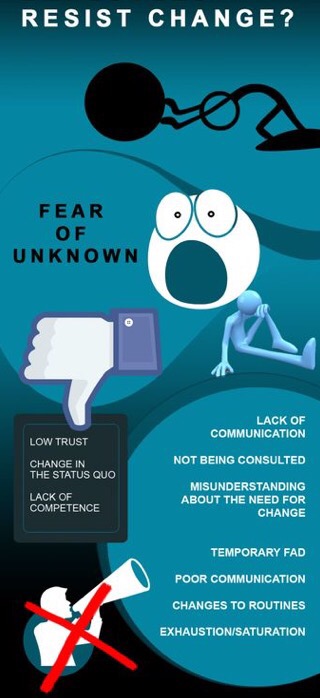
We resist change. Here’s why:

  • Parochial self-interest
  • Misunderstanding
  • Lack of trust
  • Different assessments
  • Low tolerance for change


Here’s how we show it:

Active resistance: Lack of cooperation together with disputes, threat of strikes, and sabotage.

Opposition : Delay, not meeting deadlines or having resources ready when they are needed, and forming coalitions to overturn the change.

Conditional acceptance : Accepting the essence of change while working on its modification.

False acceptance:  Pretending to accept the job while doing nothing to implement it.

Acquiescence:  Accepting the change while reducing commitment to the organization.

Withdrawal:  People simply leave the organization or transfer to another job within the organization that is not affected by the change.

4 Successful Change Management Tactics

We can successfully manage change through persuasion, intervention, edict, and participation.  Of the four … persuasion, intervention and participation will more often result in commitment to change, rather than compliance.

  1. Persuasion. The manager articulates the needs and opportunities and then an expert sells the plan to other managers and subordinates.
  2. Intervention. Identify deficiencies, state new objectives and illustrate how these will be met through members of the organization.
  3. Participation. The manager states the problem, delegates responsibility for deriving solution to a planning group, and then provide for implementation of the planned solution.
  4. Edict is less effective because it operates under the dictatorial mode through ordering everyone to follow the stated change plan. This leads to compliance rather than resistance.

To better manage the natural resistance to change in order to sustain performance in an environment of constant change it is best to:

  • Personalize the benefits of change;
  • Lead, sponsor and communicate throughout the change process;
  • Support people through the difficult points of the change journey;
  • Focus on new behaviors not new attitudes.

Essentially, we can never hide from change. It is inevitable. The traditional form of managing change may be adequate in a slow moving world.  However, in our pop Tart rapidly changing social media environment, the traditional forms of management makes implementing change more difficult.  Therefore adapting the tactics mentioned will go a long way to fuel lasting commitment that will promote business success in the long term.

If you are not in business, you can still apply the same tactics to your own personal life, career, and relationships. Change impacts us all but it is important to remember… when it hits.. no matter what it is

Change the plan but not the Goal

Cheers!

On 2nd Thoughts: Leadership & Power

If you build it, will they come?

Leadership as the ability to cause other persons to act in desired ways for the benefit of the organization or group

As the citizens of the United States prepare for the passing of the baton to another President, it might be worth it to pause and reflect on leadership and power. Many are having Second Thoughts about what to do to influence the passing of the baton to another incumbent.

For that matter, our reflections turn to consider what is leadership? What is power? How can leaders positively influence the action of others? Is there a right way? Is there a wrong way? Does it differ at the worldwide level from that of the organizational and individual levels? These questions have tugged at my mind as I contemplated the sources of power and sought to identify individuals in organizations who exemplify these attributes.

Leading Leaders

img_6367

Selacuse in his book “Leading Leaders” discussed the category of powerful people whom he defined as the ‘elites’. Despite the natural negative connotation derived from this term, these are individuals who have “more” – more education, more talent, more money and more clout than ordinary people. Their knowledge, skills, money or power give elites (customarily leaders) special privileges.

A Bushy Comparison

Persuasion before action

Moreso Selacuse defined leadership as the ability to cause other persons to act in desired ways for the benefit of the organization or group.  He conveyed an interesting spin on contrasting leadership at the presidential level. A comparative analysis was done on the leadership style of President George H.W. Bush with the leadership of his son President George W. Bush.  Father Bush strongly believed that if other nations were to join the coalition to drive Iraq from Kuwait, the United States had to take an active, energetic leadership role in convincing them to join the coalition.  He believed that leadership required diplomacy across a broad front and exhibited this through direct contact with other world leaders.  Moreover, he did this through diplomatic missions; through action at the United Nations and other international organizations; through foreign embassies in the United States; and through American ambassadors abroad – to build and maintain a coalition of nations united in their efforts to achieve the goal to drive Iraq from Kuwait.  George H.W. Bush’s leadership was based on persuasion before action.

If you build it will they come?

In contrast to his leadership style, his son George W. Bush acted under the belief that other countries had no choice but to follow the United States.  George W. Bush and his administration believed that leadership by the United States seemed to flow automatically from its status as the world’s only superpower.  At the time, the administration made it publicly clear that if other countries did not follow the U.S. into the war against Iraq, they would go to war alone.  That certainly deviated from the importance of creating a coalition.  They believed that unilateral action by the U.S. would naturally lead to multilateral action by other countries.  The “if you build it they will come” doctrine expressed the belief that the United States was a unique country not just in terms of its power but also its moral authority for using that power.

To summarize this comparative analysis, Bush – the father, had broad experience in international diplomacy and long-standing relationships with world leaders at that time. He intimately knew and was on a first-name basis with national leaders and used this to his advantage to influence worldwide leaders.  On the other hand, his son had no previous diplomatic experience and did not know the foreign leaders.  Therefore, he often delegated important tasks to other members of his administration. Naturally then, he did not have the influence that his father did.  In my opinion, this was indeed an interesting view on the issue of leadership and power at the global nation-wide level.

Definitely something to consider as we step into the future of our country, organizations or at the individual level of leadership, power and success.

Choose wisely.


Being Micro Managed?


You Micro Manager! Yes you. Repeat after me…I will not micromanage. I will not micromanage. I will not micromanage. These are the best words of caution for new managers.

Micromanagement is a management style whereby a manager closely observes or controls the work of subordinates or employees. Micromanagement generally has a negative connotation. Wiki

I was asked the question why some managers feel it necessary to micro manage. Reflecting on that I decided to share through this post.

Managers who micromanage makes coming to work a nightmare. Micro Management is the practice of managing with excessive control or attention to detail. It tells employees that there is a lack of trust. Essentially that the manager has little confidence in his/her team and their capabilities. Often it drives the team away and what is worse, it is the organization’s most talented people who frequently walk away. The company is then left with those workers who will simply show up for a ‘paycheck’. No commitment, no care.

Signs of Micro Management

If you are a micro manager, Harvard Business shared signs that can be seen:

  • You’re never quite satisfied with deliverables
  • You often feel frustrated because you would have gone about the task differently
  • You laser in on the details and take price and/or pain in making corrections
  • You constantly want to know where all your team members are and what they are working on
  • You ask for frequent updates on where things stand
  • You prefer to be cc’d on emails

As a manager, this is certainly grounds for disaster. You will either drive your team crazy or stress yourself out with the inevitable burn out.

How to Manage:

As a new manager if you find yourself micro managing here are a few points to keep in mind:

  • Don’t be afraid to fail. At its very core is the feeling that if you don’t do things yourself, things are going to fail. Not so. This is a myth. Sometimes failure is good. It helps us learn and grow, and our teams may end up with the belief that you are ‘human’. They will work together with you to achieve the results. Essentially, you will win.

img_7135

  • Focus on the ‘what’ not the ‘how’. I am a firm believer in sharing the organization and your department’s goal with your team.  Doing so stimulates their creativity and provides solutions that you may not have considered.
  • Let it go. The difference between managing and micromanaging is in the ‘micro’. Let go of watching people. Here’s how:

-Look at your to-do list to see which task can be passed on or delegated to those reporting to you.

-Engage your team. Let them know what level of detail you expect from them and where they need to connect with you.

-Think Big. Focus on the big issues that you need to concentrate on and place your energy and attention on those.

Being Micro-Managed?

If you are being micro-managed, Research Psychologist Dr. Peggy Drexler suggests a few pointers you can use to remain sane:

  • Do your job well.
  • Ask how you’re doing
  • Be a proactive communicator. Copy supervisor on emails. Keep him/her up to date on your activities before being asked.
  • Teach him/her how to delegate. Volunteer to help with tasks or projects and keep your manager abreast of the progress.

Practicing these points will help you succeed. The converse is also true. Continuing to micro manage is Ancient…a thing of the past where autocratic leadership was game. Doing this now is sure grounds for disaster.

So it’s your choice. Choose wisely and experience success.

Radical Steps To Deal With A Bad Boss

We show up everyday doing a job that we don’t like, and then feel like we are losing our mind when we are expected to be productive and profitable.

Get angry! Tell them off on national TV-like that famous weather reporter did! Give them a piece of your mind-like that flight attendant did, then de-planed! Or quietly sneak away never to return again, which unfortunately happens too often.

Though we may smile at these examples, they are real life situations that actually happened. As a HR consultant, I have worked with clients that have had these experiences and more. Because we spend most of our time at work, it would be great for us to really like what we do, and who we have to work with.

Vincent Van Gogh said that he put his heart and soul into his work and lost his mind in the process.  How many of us really feel that way?  We show up everyday doing a job that we don’t like, and then feel like we are losing our mind when we are expected to be productive and profitable. It’s hard. But we keep at it if we are to cover our basic needs to survive, thrive, or for those at the higher levels, fulfill our higher need to self-actualize. 

STRATEGIES FOR DEALING WITH A BAD BOSS

If you have a bad boss…see qualities in 23 signs you have a Bad Boss, it is not likely that you are going to change them. So here are a few strategies to help you take the steps to work better with him or her.

  • Have an early, upfront conversation about what is important to you in a leader and how you can best work together. In a civil manner, discuss things such as:
    • Leadership style and the coaching you would need to develop.
    • Expectations. What he/she expects from you, and what you expect.
    • Perception. How each of you perceive “success” with regard to the job.
    • What “meets expectations” or “exceeds expectations” look like on the performance-rating continuum.
    • Your current performance


  • Be proactive and check in with him or her often to provide reports, or updates.
  • Acknowledge them publicly for their support, especially when they have been instrumental in helping you succeed.
  • If problems occur that escalate, have a conversation with the HR manager to ensure that any complaints are logged. HR will take the necessary steps to help resolve the issue and can serve as a mediator in future meetings.
  • If 360-degree feedback systems, and other anonymous options are in place in your organization, do use them to provide input regarding your concerns.
  • Keep a record of dates, times, and specific examples of issues that have occurred so that you will be able to recall them when necessary.

Essentially, do your best to try to work with the situation you are charged with at the moment. Nothing lasts forever. Things do change sometimes. But by all means, if the horizon really looks bleak in that company, then start the process to move on, especially if  it starts to negatively affect your health. Start the job change process to search for a new opportunity. Take the steps to:

  • Update your Resume
  • Refresh your LinkedIn Profile
  • Connect with a Recruiter
  • Consider other career options

It’s important to heed the caution before you make such Radical change….Making irrational decisions then saying “oh wait”, will be too late.  So be cautioned that you never leave a job without first finding another one. It will be well worth it in the long run.


23 Signs You Have a Bad Boss


We have all had to deal with bad bosses at one time or the other throughout our career. We scream, complain, lose the Zing, become demotivated, do barely enough to get by, or inevitably jump ship. If you are dealing with a bad boss here are a few examples of characteristics  that depicts the behavior.


Common Bad Boss Behavior

img_6747

  1. Lack of vision and inability to communicate effectively
  2. Micromanaging
  3. Thinking you have all the answers and that you must have all the answers
  4. Working late everyday
  5. Poor Hiring Decisions
  6. Failure to Admit Mistakes
  7. Takes the credit but gives the blame
  8. Does not Lead by Example
  9. My way or the high way
  10. Mistakes being liked for being respected
  11. Provides little/no feedback or coaching
  12. Shows favoritism
  13. Task-focused vs team-oriented
  14. Embraces the status quo
  15. Being a good ‘doer’ means you will be a good manager
  16. Selects and leads based on “like me”
  17. Ignores diversity of thought or varying opinions
  18. Past focused vs present/future
  19. Lacks courage
  20. Being a friend instead of a leader
  21. Failing to delegate and demonstrate trust
  22. Allowing ego and pride to get in the way of good decisions
  23. Personal agendas/motives

If you are a new manager, reflect on these characteristics. Recognize the signs and plan to change. You will then be on your way to becoming a good leader.

Of Clouds And Vision

Business, career, family, life and the facets that engulf our daily experiences. Clouds like scales cover our eyes that we fail to see the Vision of a future so dear. A future that’s past reminiscing what has been…, blocks the possibilities of what can be.
Open wide our eyes. See the possibilities. Reach higher. Believe. We will Achieve.


<a href=”https://dailypost.wordpress.com/prompts/clouds/”>Clouds</a&gt;

Employers are Paying More for These…

FullSizeRender (7)

We all go through different phases in our lives. Let’s face it, our careers are intertwined in our everyday lifestyle. We strive to be educated whether in a formal educational institution; through our life experiences; or a combination of both. Our dreams, goals, and aspirations range from starting and raising a family, getting our dream home, building our business, and the list goes on. All are intertwined in life’s journeys.

“The U.S. is basically at full employment” …. statement made by CNN Money in their article on employment. Whether or not we agree, jobs have been added….maybe not the ones we like, or at the salary that we want, but that was the finding.

So what are employers paying more for? Here are the top 21 skills gleaned from Money Magazine that revealed the findings of payscale.com money research. These high demand skills give us the best reach for getting a higher salary to advance us to the next phase of our lives. Skills listed in order of highest paid to lowest.

  1. SAS (Statistical Analysis System)
  2. Data Mining/Data Warehousing
  3. Search Engine Marketing
  4. Data Modeling
  5. Contract Negotiation
  6. Software Development
  7. Strategic Project Management
  8. Strategic Planning
  9. Technical Sales
  10. Customer Service Metrics
  11. Financial Analysis
  12. Risk Management / Risk control
  13. SAP Material Management
  14. Business Analysis
  15. IT Security and infrastructure
  16. Lean Manufacturing
  17. Forecasting
  18. Clinical Education
  19. Computer-Aided Design/Manufacturing
  20. Systems Troubleshooting
  21. New Business Development

Take a look at the list again to see where your interests lie. Examine your current skills, capitalize on them, or plan to build any gaps. Stay tuned for our next discussion on the Most Flexible Career Skills if you are looking to jump to a new job, or industry.

<a href=”https://dailypost.wordpress.com/prompts/phase/”>Phase</a&gt;

Travel with Intent

A photographer's view of the world - words and images to inspire your travels and your dreams

Answering daily prompts

In this blog I'm attempting to answer wordpress daily prompts

Alex Tafur

Property Maintenance

Poesy Perspectives

embrace the magic

GREENLiGHT

When God Says Go

HEALTH | INSPIRATION

Health, Reflection, and Poetry for the Journey of Life

My Sister My Friend

Family. Youth. Parenting

Kamileon Photography

Your Focus. Our Lens.