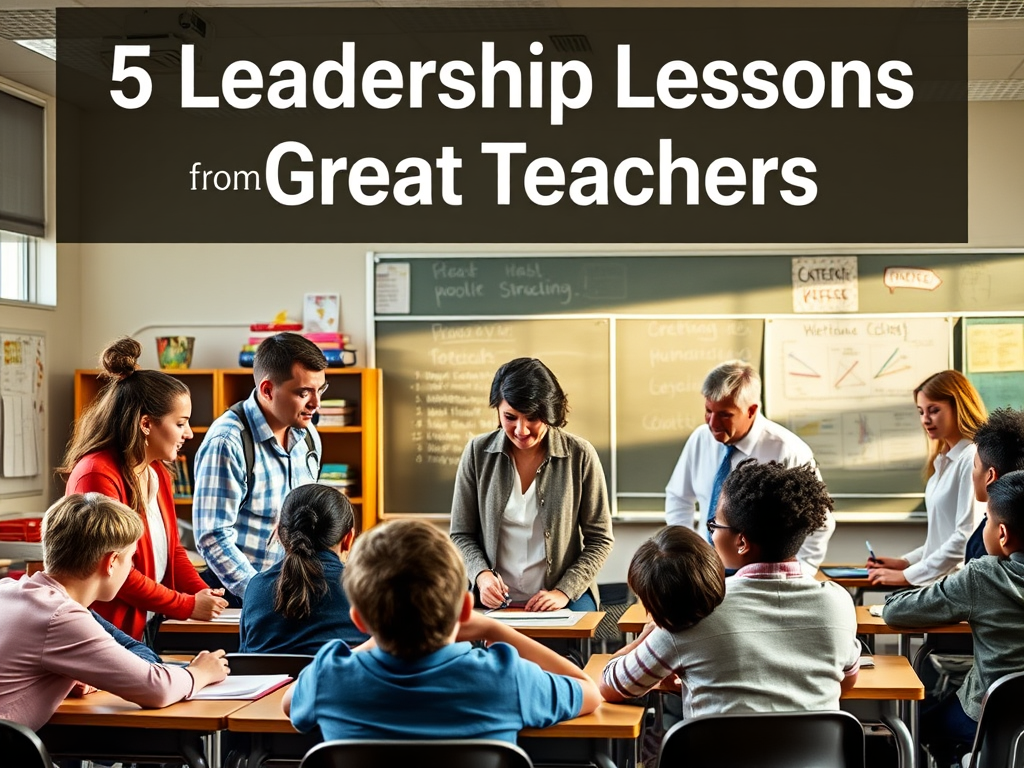
5 Leadership Lessons from Great Teachers

Dead Poets Society

Clarity builds trust and momentum

Summer is almost over and it’s time to make all those back-to-school plans. As we make those plans, lets pause for a minute. Think of a teacher or two who made a difference in your life. Personally, as I age, I think about those teaching experiences and the effect they had on my leadership journey. As I look back, I think of society’s great teachers like Erin Gruwell, Maria Montessori, and the fictional Mr. Keating (Dead Poets Society).

Here are 5 lessons leaders can learn from great teachers.

1.Clarity is Powerful

Teachers break down complex topics into simple, digestible pieces.
Leaders must do the same—clearly communicate vision, expectations, and feedback so everyone understands what success looks like.

Lesson: Say less, mean more. Clarity builds trust and momentum.

2. Patience Enables Progress

Teachers know learning takes time and that growth isn’t always linear.
Leaders should extend grace and patience during times of transition, failure, or new learning curves—whether with teams or themselves.

Lesson: Progress often looks like repetition before results.

3. Individual Strengths Matter

Great teachers recognize that not every student learns the same way.
Great leaders acknowledge that not every employee works, leads, or grows the same. They tailor support, roles, and recognition accordingly.

Lesson: Personalize your leadership to bring out the best in each person.

4. Structure Creates Freedom

Teachers use routines and structure to create a safe space for creativity and exploration.
Leaders who implement clear systems give their teams the confidence and autonomy to take initiative.

Lesson: Strong frameworks unlock innovative thinking.

5. Passion Inspires Performance

Teachers who genuinely care spark curiosity and motivation.
Leaders who lead with purpose, authenticity, and heart cultivate higher engagement and loyalty.

Lesson: When you model passion, people give their best

As school begins its opening session, the road becomes a task / lesson plan in and of itself. What are your thoughts on the top five lessons? Anything missing that you would like to add? Do share, we would love to hear.

Don’t forget to connect if you would like to discuss your own leadership growth journey.

What’s The Perfect Door Prize? 21 Gift Ideas for Networking Events That Shine

Show up. Let yourself be seen. ~Brene Brown

What’s a networking event without door prizes? Boring (smile). So, event organizers encourage gifts. They are a simple yet powerful way to boost engagement, excitement, and attendance at networking events. They create a sense of the anticipation and fun, making the event more memorable for participants. Door prizes also encourage people to arrive on time, stay longer, and interact more freely with others. Besides entertainment, they offer a subtle marketing opportunity for sponsors, hosts, or businesses to showcase their products or services in a positive light.

The PSL Business Club asked the question: What is the Perfect door prize to give away at networking events?” Members chimed in. Some suggested giving what you would like to receive. Others suggested giving away high-end gifts that will make you the talk of the event. Gift these over several periods and you’re sure to leave a lasting memory. Here I share key gift ideas extracted as members chimed in.

Gifts That Shine

  1. Wellness bundle energy drinks
  2. Journal, fun pen, small devotional or motivational card set
  3. Cute mugs which says “let’s connect over coffee”
  4. Pair a small gift care ($10-$15) with a handwritten note or business card enclosing a product sample
  5. Branded item that’s actually helpful
  6. Gift cards to local restaurants.
  7. Something useful like Coffee gift cards
  8. Wine or Vodka
  9. Dark chocolate and a gift card or voucher to try branded services
  10. Cool shirt
  11. Stanley or Yeti cup
  12. Gift baskets
  13. Branded swag bundle from the host company
  14. Branded items or one/two from local businesses or gift certificates
  15. Candy
  16. Homemade cookies
  17. Hand-painted items
  18. Chocolates from a chocolatier
  19. Beach accessories
  20. Fun items that’s non-business related
  21. Dot card… to make sharing information easier at networking event

High-End Gifts

Higher end gifts creates a lasting memory of your brand. Such gifts are:

  • Massage or Spa packages
  • Weekend getaway at hotel
  • Dinner for two at a high-end/classy restaurant
  • Tickets to a concert/play

There you have it! Here’s hoping it takes the guess work out of your gift giving when attending your next event.

The Pain of Not Embracing Coaching

Innovation Distinguishes. A group of cross-cultural leaders gathered together to discuss the Cultural Undervaluing of Professional Coaching. Education is a crucial pillar of development, but it is not the full structure. Professional coaching, especially in career planning, mindset growth, and personal branding, is often seen as optional, extravagant, or even unnecessary.

Chris, Maxine, and I, focused on The Pain of Not Embracing Coaching. It has many effects. Here are a few:

Underdeveloped Potential

Talented individuals stay stuck in survival mode. They fail to unlock their genius because no one helps them think strategically about their growth.

Career Plateau

Professionals with great resumes stall out due to poor networking, weak positioning, or self-limiting beliefs.

Global Irrelevance

In our rapidly changing world where soft skills, emotional intelligence, and AI adaptability are premium assets, people fall behind.

Silent Suffering

Many carry silent frustrations; “I’m better than this, but I don’t know how to rise.” Coaching could be the very bridge out of that quiet despair.

Join the conversation. Let’s hear your thoughts.
Rather a private chat? Chat me now.

Vibrant Perspective

Crowded Airport when a woman exclaimed “I love your colors”. Adorned in summer colors, I replied crazy, right? Ahhh vibrancy she chirped. Vibrancy.

I leaned over and whispered back with a smile “vibrancy” and walked on.

I thought of that interface with a complete stranger. Such simple passerby exchange yet amicable. It left me thinking about perspective. It’s late evening and I’m taking the last flight out. I Only wanted to take a carryon to my out of state meeting so I placed the hot yellow necklace around my neck. Added the orange shoes with a red pants. But I’m known for that. I do things others are afraid to do, all with a purpose… my purpose to take one bag (smile)

How about you? Do you do things that perturb others leaving them wondering… could that be me? Do share. We would love to hear.

Cheers!

Photo by Rachel Claire on Pexels.com

Life Or Lipstick?

You are just one decision from a totally different life. ~Wilfred A. Peterson

Life or lipstick? Silly question. I was driving when I looked in the mirror and saw ‘dry lips’. If you know me well, I don’t like to go anywhere without my lipstick or some color on my lips.

Immediately I began rummaging in my handbag. One hand on the steering wheel and the other attempting to do a deep dive (women’s handbag).

Suddenly I realized my foolery and said to myself life or lipstick? That immediately put things in perspective.

Haven’t we all made some decisions that when we look back at the short term benefits did not make any sense?

Sometimes you make the right decision. Sometimes you make the decision, right. ~ Phillip C. McGraw

Life Choices

  • Why would I choose lipstick over my life?
  • Why would you quit a job without having another source of income?
  • Why would you stay in a relationship that’s harmful? After all you’re not even married?
  • Why would you start a business without a plan? Without capital?
  • Why would your health not be considered during food consumption

We could go on and on. Let’s choose to be wise about the decisions we make and their effect on life.

The quality of your life is built on the quality of your decisions

Have an important decision to make? Think it over closely. Weigh the pros and cons. Talk it over with a confidante or leadership coach.

Cheers!

The Power of the In-Between: Leading Through Life’s Transitions

Sometimes God brings times of transition to create transformation. ~Lynn Cowell

Transition is not a sign that something’s gone wrong.
It’s often a sign that something deeply right is trying to emerge.

Whether you’re navigating a career pivot, stepping into leadership, returning to yourself after raising children, grieving a loss, starting over, or simply outgrowing who you used to be — you are not lost.

You are in motion.
And motion is sacred.

Transitions Aren’t Detours

So many of us have been taught to treat transitions like detours. Inconveniences. Delays.
But in my experience — and maybe in yours too — transitions are not detours. They are invitations.
Invitations to pause.
To listen.
To lead our lives more deliberately.

There’s a quote I love:

Sometimes when you’re in a dark place, you think you’ve been buried but actually you’ve been planted

So if you’re feeling buried right now — by uncertainty, or fear, or change — know this:
You’re not stuck.
You’re becoming.

Whether it’s career change, motherhood, empty nesting, loss, or reinvention — transitions are not delays. They’re sacred invitations to pause, realign, and step into something deeper.

Who You Are Becoming is Just as Important as What You’re Doing

Our default in transition is to rush into action.
Update the resume. Apply for roles. Rebrand the business. Hustle harder.
But what if the first step wasn’t “What should I do?”
What if it was: “Who am I becoming?”

Because clarity doesn’t come from more motion.
It comes from alignment. From asking:

  • What do I no longer want to carry?
  • What am I being called to step into?
  • What version of me is ready to emerge?

This is your opportunity to shape your next self, not just your next job title, or business pivot, or life chapter.

You Don’t Have to Navigate This Alone

One of the hardest things about transitions? They can feel so lonely.
Especially for women who are used to being the strong ones, the fixers, the go-to for everyone else.

But here’s what I want to say to you today:
You are not alone. And you’re not the only one feeling “in between.”

Let this season be one where you ask for help.
Where you find community.
Where you give yourself permission to rebuild — slowly, honestly, bravely.

Because you don’t have to have it all figured out to move forward.
You just have to decide you’re worth the becoming.

Wrapping it Up

So if you’re in transition today — good.
It means you’re alive.
It means something inside you is shifting. Growing. Healing.
Honor that.

You don’t need to go back to who you were.
You are being invited to rise into who you’re becoming.

And I promise — she is worth the wait.

Going through a transition and feeling confused? Let’s connect

Cheers!

Success Stories: 15 Women of Color Who Self-Published

“A word after a word after a word is power.”

Margaret Atwood

The publishing process can be intimidating for an unknown writer. The traditional Agent-Publisher-Author relationship is hard. Rejection after rejection is common as Agents say ‘no’. Writers become discouraged and often give up. Manuscripts stay in the darkness of desk drawers for years.

As time has involved, so has the advent of self-publishing. Writers become bold and take advantage of their publishing plight. They make bold moves; step ahead, take the reins to achieve their publishing goal of becoming an author. With low budget and unplanned expenses, some cut corners and quality becomes compromised. Book covers are mediocre. Titles lack depth. Formatting is non-existent, which leads to the demise of some great manuscripts.

On the other hand, some writers step out, work hard, invest, learn the process, and viola! Success follows!

Self-Publishing Success

Here are 15 Authors of color who achieved significant success through self-publishing:

  1. Toni Morrison – While primarily known for her traditionally published works, she self-published her first novel “The Bluest Eye” before gaining wider recognition
  2. Terry McMillan – Initially self-published her debut novel “Mama” before securing a publisher for subsequent works
  3. N.K. Jemisin – First self-published some of her fantasy work before becoming the first author to win the Hugo Award for Best Novel three years in a row
  4. Alexandria House – Found success self-publishing contemporary romance novels featuring Black characters
  5. Kristen Ashley – Built a dedicated following through self-publishing her romance novels before signing with traditional publishers
  6. Brenda Jackson – Pioneer in African American romance who began with self-publishing before becoming a New York Times bestseller
  7. Alyssa Cole – Initially self-published her diverse romance novels before becoming an award-winning author
  8. K.M. Jackson – Self-published romance author who found success writing diverse contemporary stories
  9. Nikki Turner – Self-published her first urban fiction novel before becoming known as the “Queen of Hip-Hop Fiction”
  10. Beverly Jenkins – Started self-publishing historical romances featuring Black characters when traditional publishers showed little interest
  11. Sister Souljah – Self-published “The Coldest Winter Ever” which became a groundbreaking street lit phenomenon
  12. Nnedi Okorafor – Self-published some of her early Africanfuturist works before winning multiple prestigious awards
  13. Kiini Ibura Salaam – Award-winning speculative fiction writer who self-published collections of her short stories
  14. Octavia Butler – Though mostly known for her traditionally published works, she self-published some early stories
  15. Zane – Built an erotic fiction empire beginning with self-published works before launching her own publishing company

These authors demonstrated outstanding entrepreneurial spirit and literary talent often creating space for Black women’s voices. This occurred at a time when traditional publishing wasn’t receptive to their work. Many of these women went on to sign traditional deals. Suffice it to say they proved their commercial viability through self-publishing. Others maintained independence throughout their careers.

Need help to get over your fear to make the leap? Let these women inspire your journey. Thoughts about any of these or other women of color who have experienced success? Do share. We would love to hear.

Cheers!


Setting Boundaries: A Key to Work-Life Balance

SAY NO

Stop asking why they keep doing it and start asking why you keep allowing it.

Setting boundaries involves defining expectations and limits in relationship (Positive Psychology). Here are 5 characteristics to help balance your work/ life.

1. Self-Care Prioritization

  • Regular exercise
  • Quality sleep
  • Healthy nutrition
  • Meditation/stress management techniques

2. Boundaries Setting

  • Clear work-life separation
  • Learning to say no
  • Limiting overtime
  • Scheduling personal time

3. Professional Support

  • Discuss workload with supervisor
  • Seek workplace accommodations
  • Consider professional counseling
  • Join support groups

4. Mental Reset Techniques

  • Take regular breaks
  • Practice mindfulness
  • Use vacation days
  • Pursue hobbies outside work

5. Systematic Recovery

  • Identify stress triggers
  • Develop coping strategies
  • Regular mental health check-ins
  • Gradual lifestyle adjustments

Here’s hoping these tips will help you achieve your work / life balance goals.

Understanding Emotional Exhaustion: 5 Key Signs

Self-care is how you take your power back

Lalah Delia

Long days at work, inability to meet financial needs, household chores, relationship strains. All these can take a toll on us at times. Here are 5 signs associated with burnout. Read and examine each. Then apply it to yourself.

1.Emotional Exhaustion

Feeling drained, overwhelmed, and unable to recover from daily stressors, with persistent mental and physical fatigue.

2.Decreased Performance

Reduced productivity, struggling to concentrate, missing deadlines, and experiencing a significant drop in work quality.

3.Detachment and Cynicism

Developing a negative, indifferent, or callous attitude towards work, colleagues, and responsibilities. Feeling disconnected and unmotivated.

4.Physical Symptom

Experiencing frequent headaches, sleep disruptions, changes in appetite, weakened immune system, and increased vulnerability to illness.

5.Lack of Work-Life Balance

Feeling constantly preoccupied with work, inability to disconnect, neglecting personal relationships, hobbies, and self-care activities.

Are you experiencing one, two, or a few of these signs? Stay tuned for practical solutions. Any missing that you would like to add? Do share, we would love to hear.

Cheers!

Photo by Frank K on Pexels.com

Why Year-End Triggers Career Reflection

You can get excited about the future. The past won’t mind. ~Hillary DePiano 

The end of the year naturally invokes a period of career reflection, which serves as a psychological milestone that compels professionals to pause and assess their journey. As the calendar approaches its final weeks, individuals are instinctively drawn to introspection, triggered by a combination of cultural traditions, personal goal-setting practices, and an innate human desire for growth and meaning. This time of reflection is fueled by the contrast between the year’s accomplishments and unfulfilled aspirations, creating the opportunity for honest self-evaluation (hint …that common ideal weight loss plan).

Also read: Conquering Transition Doubts

The approaching new year symbolizes renewal and potential, encouraging professionals to reflect on their career trajectory, measure progress against past objectives, and recalibrate their professional vision. Factors like annual performance reviews, financial assessments, industry shifts, and personal life changes converge during this period, making it an ideal time to critically reflect on career satisfaction, skill development, alignment with long-term goals, and potential opportunities for growth or transformation.

Consequently, here are a number of pointers that discusses this period of reflection along with recommendation. Not a self-starter , we can help.

Natural Evaluation Period

  • Annual performance reviews
  • Reflecting on past year’s achievements
  • Setting new personal goals
  • Psychological reset moment

Emotional Triggers

  • Holiday season brings perspective
  • Family gatherings prompt life discussions
  • Increased time for self-reflection
  • Motivation from new year anticipation

Professional Burnout

  • Accumulated workplace stress
  • Desire for meaningful change
  • Recognizing current job’s limitations
  • Seeking personal fulfillment

External Evaluation

  • Social conversations about resolutions
  • Seeing others make bold moves
  • Increased motivational content
  • Feeling inspired by potential

Strategic Approach

  • Budget reassessment
  • Career growth opportunities
  • Market trend observations
  • Personal development planning

Motivational Approach

  • Embrace fear as growth signal
  • Start with small, low-risk steps
  • Build confidence gradually
  • Seek professional guidance
  • Create solid transition plan

Recommended Actions

  • Self-assessment
  • Skill inventory
  • Informational interviews
  • Part-time exploration
  • Professional coaching
  • Continuous learning

Are you experiencing any of these signs? If so, it’s time to do something about it. Adapt the motivational approach along with the recommended actions. But if you need the expertise of a coach who can help. Better yet, purchase a gift certificate for a friend experiencing these signs and help him/her kick off the new year with a difference.

Making Big Decisions: Head Or Heart?

Decisions. Decisions

A new year paves the way for ‘change’. As we approach 2025 many of us will make decisions that will impact our lives. Decisions in our entrepreneurship roles, decisions in our relationships, career (stay or go), and in our personal and professional lives.

The question was asked on social media about decision-making. When making decisions do you make them using your ‘head’ or ‘heart’. Respondents quickly chimed in with 29% preferred ‘head’, while 71% preferred ‘heart’. Decided to break down head decisions vs. heart decisions and analyze their roles and characteristics in decision-making.

Head Decisions (Rational / Logical)

  1. Characteristics:
  • Based on facts and data
  • Relies on analysis and reasoning
  • Focuses on practical outcomes
  • Uses systematic evaluation
  • Considers long-term consequences
  • Weighs pros and cons objectively
  • Driven by logic and evidence
  1. Best Used For:
  • Financial decisions
  • Business strategies
  • Career choices
  • Investment planning
  • Risk assessment
  • Legal matters
  • Technical problems

Heart Decisions (Emotional / Intuitive)

  1. Characteristics:
  • Based on feelings and intuition
  • Relies on personal values
  • Focuses on emotional satisfaction
  • Uses gut instincts
  • Considers personal fulfillment
  • Weighs emotional impact
  • Driven by passion and purpose
  1. Best Used For:
  • Personal relationships
  • Creative pursuits
  • Life purpose decisions
  • Value-based choices
  • Personal fulfillment
  • Passion projects
  • Meaningful connections

Which is Better?

Neither is “better” – both have their place

  1. Integrated Approach:
  • Best decisions often combine both
  • Head ensures practicality
  • Heart ensures alignment with values
  • Balance creates sustainable choices
  1. Context Matters:
  • Some situations need more logic
  • Others need more emotional intelligence
  • Most benefit from both perspectives
  1. Decision Framework: Best Practice: Use Both
  • Heart: Initial guidance
  • Head: Validation and planning
  • Heart: Final gut check
  1. When to Lean More on Head:
  • High-risk situations
  • Financial commitments
  • Legal matters
  • Complex problems
  • Strategic planning
  1. When to Lean More on Heart:
  • Life purpose decisions
  • Personal relationships
  • Career passion
  • Creative endeavors
  • Value-based choices
  1. Integration Tips:
  • Start with heart to identify what matters
  • Use head to evaluate feasibility
  • Check back with heart for alignment
  • Plan execution with head
  • Monitor satisfaction with heart
  1. Warning Signs: Head-Only Decisions:
  • Feels empty or unfulfilling
  • Lacks personal meaning
  • May lead to regret
  • Could miss opportunities

Heart-Only Decisions:

  • May be impractical
  • Could be financially risky
  • Might lack sustainability
  • Could be too impulsive

Real-World Example: Career Change Decision:

  • Heart: Identifies passion and desired impact
  • Head: Evaluates market demand, salary, skills needed
  • Heart: Confirms emotional alignment
  • Head: Creates transition plan
  • Both: Monitor progress and satisfaction

Recommendation

  1. Use a Balanced Approach:
  • Start with heart to understand what you truly want
  • Use head to evaluate feasibility and plan
  • Check back with heart for alignment
  • Execute with head’s planning
  • Monitor with both heart and head
  1. Decision-Making Process:
  • Identify the type of decision
  • Consider the stakes involved
  • Use appropriate balance of both
  • Create evaluation criteria
  • Make and implement decision
  • Review and adjust as needed
  1. Questions to Ask: Head Questions:
  • What are the facts?
  • What are the risks?
  • What are the long-term consequences?
  • What resources are required?

Heart Questions:

  • How does this feel?
  • Does this align with my values?
  • Will this bring fulfillment?
  • What does my intuition say?

Points to Note

  • The best decisions often come from balanced input from both head and heart
  • Different situations require different balances
  • Practice integrating both perspectives
  • Trust both your logic and your intuition
  • Monitor outcomes using both metrics

So there you have it. A thorough overview of when and how to make decisions with your head and heart. What type of decision-maker are you? Head or Heart? Do share, we would love to hear.

Ahh Coaching: Trouble The Comfortable

The interesting thing about coaching is that you have to trouble the comfortable and comfort the troubled.

Ric Charlesworth

Professional development involves coaching. It is a process of self-awareness, application and reflection. Improving yourself through learning and training has advantages. Just as great sportsmen hire coaches, professionals can improve their craft with a personalized and objective coach.

That said, people’s perceptions of coaching necessity vary and there are myths, but there is a growing recognition of its value in professional development.

  1. General perception: There’s been an increasing trend towards viewing coaching as valuable, particularly in corporate settings. However, it’s not universally seen as “necessary.”
  2. Executive coaching: A survey by the International Coach Federation (ICF) found that about 86% of organizations saw a return on investment from coaching. This suggests a high perceived value among those who have experienced it.
  3. Leadership coaching: Many large companies now include coaching as part of leadership development programs, indicating its perceived importance.
  4. Career coaching: The demand for career coaching has grown, especially with the rapid changes in the job market and increased career transitions.
  5. Percentage who think it’s necessary: It’s challenging to give an exact percentage as perceptions vary widely across industries, cultures, and individual experiences. However, here are some relevant statistics:
    • A study by the Harvard Business Review found that 48% of CEOs who had coaching said they were open to changing their behavior as a result.
    • According to a report by PwC, 50% of firms surveyed used coaching as a key part of their learning and development programs.

These numbers suggest that while coaching is increasingly valued, it’s not universally seen as “necessary” by everyone. The perception tends to be more positive among those who have experienced coaching or work in organizations that regularly use coaching services.

It is important to note that these figures can change over time and may vary significantly depending on the specific context (e.g., industry, individuals, company size).

So there you have it. Different perceptions of coaching and it’s necessity. Many understand and appreciate its value. Are you one of them? What’s your own perspective? Do share. We would love to hear.

Cheers!

Travel with Intent

A photographer's view of the world - words and images to inspire your travels and your dreams

Answering daily prompts

In this blog I'm attempting to answer wordpress daily prompts

Alex Tafur

Property Maintenance

Poesy Perspectives

embrace the magic

GREENLiGHT

When God Says Go

HEALTH | INSPIRATION

Mind • Body • Life

My Sister My Friend

Family. Youth. Parenting

Kamileon Photography

Your Focus. Our Lens.