The Pain of Not Embracing Coaching

Innovation Distinguishes. A group of cross-cultural leaders gathered together to discuss the Cultural Undervaluing of Professional Coaching. Education is a crucial pillar of development, but it is not the full structure. Professional coaching, especially in career planning, mindset growth, and personal branding, is often seen as optional, extravagant, or even unnecessary.

Chris, Maxine, and I, focused on The Pain of Not Embracing Coaching. It has many effects. Here are a few:

Underdeveloped Potential

Talented individuals stay stuck in survival mode. They fail to unlock their genius because no one helps them think strategically about their growth.

Career Plateau

Professionals with great resumes stall out due to poor networking, weak positioning, or self-limiting beliefs.

Global Irrelevance

In our rapidly changing world where soft skills, emotional intelligence, and AI adaptability are premium assets, people fall behind.

Silent Suffering

Many carry silent frustrations; “I’m better than this, but I don’t know how to rise.” Coaching could be the very bridge out of that quiet despair.

Join the conversation. Let’s hear your thoughts.
Rather a private chat? Chat me now.

The Story Behind Success Strategies (And What’s Coming Next …

I love to write! It’s a passion that began during my primary education years. I reflect on those early years. Back then, my uncle (an educator and school principal), would gift me with a book on birthdays and Christmas holidays. This was his custom instead of the usual and more preferential ‘toys’. Though disappointed then, I would dive into the books reading for hours.

As life progressed and blogging became a thing, I created my first blog A Moment With Shells in 2010. Later, on completion on my postgraduate education, I formalized this blog titled Successful Leaders to share my passion. It focused on empowering developing leaders through personal growth, leadership development, and success strategies.

That was a over a decade ago. Funny how time flies when you’re having fun!

Here’s an overview of my efforts to create articles, writings, or gleanings. The idea was to uplift, encourage subscribers and visitors under the headings listed.

Goal Setting & Achievement

The blog emphasizes the importance of setting clear, actionable goals. It encourages readers to commit to their objectives, keep them visible, and seek accountability to stay on track. Inspirational quotes from figures like Jim Rohn and Tony Robbins are used to motivate readers to design their own life plans and persist in their pursuits.

Discovering Purpose & Passion

Articles guide readers in uncovering their life purpose by reflecting on personal experiences, childhood interests, and unique talents. Techniques such as visualization, journaling, and seeking feedback from friends are recommended to help individuals find fulfillment and direction.

Stress Management & Work Life Balance

The website offers strategies for managing stress and achieving a healthy work-life balance. It highlights the importance of self-care, setting boundaries, seeking professional support, and engaging in activities that promote mental well-being.

Embracing Change & Personal Growth

Recognizing when it’s time for change is a recurring theme. Writings discuss signs that indicate the need for a new direction and encourages readers to take proactive steps toward personal development. It also emphasizes the courage required to make significant life changes.

Writing, Publishing & Legacy Building

For aspiring authors, the site provides insights into the publishing process, including self-publishing and audiobook production. It also encourages writers to reflect on their life experiences and consider the legacy they wish to leave through their work.

Overall, Successful Leaders serves as a resource for individuals seeking inspiration and practical advice on personal development, leadership, career change and achieving success in various aspects of life.

Subscribe Now! Get on Board

Subscribe to keep updated on upcoming new and exciting developments. Have you been a follower? If so, how long and how have you benefited? Do share, we would love to hear!

Cheers!

Why Year-End Triggers Career Reflection

You can get excited about the future. The past won’t mind. ~Hillary DePiano 

The end of the year naturally invokes a period of career reflection, which serves as a psychological milestone that compels professionals to pause and assess their journey. As the calendar approaches its final weeks, individuals are instinctively drawn to introspection, triggered by a combination of cultural traditions, personal goal-setting practices, and an innate human desire for growth and meaning. This time of reflection is fueled by the contrast between the year’s accomplishments and unfulfilled aspirations, creating the opportunity for honest self-evaluation (hint …that common ideal weight loss plan).

Also read: Conquering Transition Doubts

The approaching new year symbolizes renewal and potential, encouraging professionals to reflect on their career trajectory, measure progress against past objectives, and recalibrate their professional vision. Factors like annual performance reviews, financial assessments, industry shifts, and personal life changes converge during this period, making it an ideal time to critically reflect on career satisfaction, skill development, alignment with long-term goals, and potential opportunities for growth or transformation.

Consequently, here are a number of pointers that discusses this period of reflection along with recommendation. Not a self-starter , we can help.

Natural Evaluation Period

  • Annual performance reviews
  • Reflecting on past year’s achievements
  • Setting new personal goals
  • Psychological reset moment

Emotional Triggers

  • Holiday season brings perspective
  • Family gatherings prompt life discussions
  • Increased time for self-reflection
  • Motivation from new year anticipation

Professional Burnout

  • Accumulated workplace stress
  • Desire for meaningful change
  • Recognizing current job’s limitations
  • Seeking personal fulfillment

External Evaluation

  • Social conversations about resolutions
  • Seeing others make bold moves
  • Increased motivational content
  • Feeling inspired by potential

Strategic Approach

  • Budget reassessment
  • Career growth opportunities
  • Market trend observations
  • Personal development planning

Motivational Approach

  • Embrace fear as growth signal
  • Start with small, low-risk steps
  • Build confidence gradually
  • Seek professional guidance
  • Create solid transition plan

Recommended Actions

  • Self-assessment
  • Skill inventory
  • Informational interviews
  • Part-time exploration
  • Professional coaching
  • Continuous learning

Are you experiencing any of these signs? If so, it’s time to do something about it. Adapt the motivational approach along with the recommended actions. But if you need the expertise of a coach who can help. Better yet, purchase a gift certificate for a friend experiencing these signs and help him/her kick off the new year with a difference.

From Fear to Freedom: Conquering Career Transition Doubts

Fears are paper tigers. You can do anything you decide to do. You can act to change and control your life; and the process is its own reward. —Amelia Earhart

Fear is real. Sometimes it retards us. Most times it’s just in our mind yet causes us to feel stuck, unable to make the move that we desire. Common is the fear to leave a career, change jobs, or reach for that promotion as we question ourselves. So, we stay where we are and before long months turn into years, years into decades and we remain in the same place.

So what can you do about it? Here is a concise breakdown of career change fears and year-end motivation.

Why Year-end Triggers Career Reflection

Common Career Change Fears

1.Financial Uncertainty

  • Potential income reduction
  • Financial stability risks
  • Fear of economic instability
  • Concerns about supporting family

2.Identity Loss

  • Defined by current professional role
  • Fear of starting over
  • Loss of established professional status
  • Questioning self-worth

3. Skill Gap Anxiety

  • Feeling underqualified
  • Learning curve intimidation
  • Self-doubt about adaptability
  • Imposter syndrome

4.Comfort Zone Resistance

  • Familiar routine feels safe
  • Fear of unknown
  • Risk aversion
  • Psychological safety in current job

Are you experiencing any of these signs? If so, it’s time to do something about it. Talk with a trusted friend or coach who can help. Better yet, purchase a gift certificate for a friend experiencing these signs and help him/her kick off the new year with a different start. Conquer those transition doubts.

Cheers!

Ahh Coaching: Trouble The Comfortable

The interesting thing about coaching is that you have to trouble the comfortable and comfort the troubled.

Ric Charlesworth

Professional development involves coaching. It is a process of self-awareness, application and reflection. Improving yourself through learning and training has advantages. Just as great sportsmen hire coaches, professionals can improve their craft with a personalized and objective coach.

That said, people’s perceptions of coaching necessity vary and there are myths, but there is a growing recognition of its value in professional development.

  1. General perception: There’s been an increasing trend towards viewing coaching as valuable, particularly in corporate settings. However, it’s not universally seen as “necessary.”
  2. Executive coaching: A survey by the International Coach Federation (ICF) found that about 86% of organizations saw a return on investment from coaching. This suggests a high perceived value among those who have experienced it.
  3. Leadership coaching: Many large companies now include coaching as part of leadership development programs, indicating its perceived importance.
  4. Career coaching: The demand for career coaching has grown, especially with the rapid changes in the job market and increased career transitions.
  5. Percentage who think it’s necessary: It’s challenging to give an exact percentage as perceptions vary widely across industries, cultures, and individual experiences. However, here are some relevant statistics:
    • A study by the Harvard Business Review found that 48% of CEOs who had coaching said they were open to changing their behavior as a result.
    • According to a report by PwC, 50% of firms surveyed used coaching as a key part of their learning and development programs.

These numbers suggest that while coaching is increasingly valued, it’s not universally seen as “necessary” by everyone. The perception tends to be more positive among those who have experienced coaching or work in organizations that regularly use coaching services.

It is important to note that these figures can change over time and may vary significantly depending on the specific context (e.g., industry, individuals, company size).

So there you have it. Different perceptions of coaching and it’s necessity. Many understand and appreciate its value. Are you one of them? What’s your own perspective? Do share. We would love to hear.

Cheers!

10 Emerging Trends Of The Executive Coaching Industry

If you walk in the footprints of others you will never make your own.

Leader overwhelm. Personal transitions. Change. Stuck. These are but a few of the signs associated with coaching. As these signs become more common, so has the evolution of the demand for coaching. No longer is it limited to basketball players, Olympians, or sports, we all need a coach. Hence the rise compounded with the needs and desires for accountability.

The executive coaching industry has been growing rapidly, driven by increased recognition of its value in personal and professional development. Here are some interesting facts and trends about the industry:

Interesting Facts

  1. Market Growth: The executive coaching industry is part of the larger coaching market, which was estimated to be worth over $2.8 billion globally in 2021 and continues to grow at a robust pace.
  2. High ROI: Studies have shown that executive coaching can offer a return on investment (ROI) of up to 700%, with significant improvements in productivity, employee engagement, and leadership effectiveness.
  3. Wide Adoption: Approximately 86% of companies utilize coaching, and about 70% of these organizations offer coaching to their executives and high-potential employees.
  4. Diverse Applications: Executive coaching is used across various sectors including corporate, non-profit, and government organizations. It addresses a wide range of leadership challenges, from strategic thinking to emotional intelligence.
  5. Credentials and Standards: The industry has seen an increase in professional standards, with many coaches obtaining certifications from organizations like the International Coach Federation (ICF) and the Center for Credentialing & Education (CCE).

Emerging Trends

  1. Integration of Technology: The use of digital tools, AI, and virtual platforms has become prevalent, making coaching more accessible and personalized. Online coaching platforms and apps are increasingly popular.
  2. Focus on Well-being: There is a growing emphasis on holistic coaching that includes mental health and well-being alongside traditional leadership and performance coaching.
  3. Data-Driven Coaching: The incorporation of data analytics and psychometric assessments is helping to provide more tailored and effective coaching interventions.
  4. Diversity and Inclusion: Coaching programs are increasingly addressing issues of diversity, equity, and inclusion, helping leaders to foster inclusive workplace cultures.
  5. Short-Term, High-Impact Sessions: There is a trend towards shorter, more intensive coaching engagements designed to address specific challenges or goals in a condensed timeframe.
  6. Group and Team Coaching: Beyond one-on-one coaching, there is a rise in group and team coaching, which aims to improve overall team dynamics and performance.
  7. Leadership Development Programs: More organizations are integrating executive coaching into broader leadership development programs, recognizing the synergistic benefits.
  8. Coaching for All Levels: While traditionally reserved for senior executives, coaching is increasingly being made available to employees at all levels, including mid-level managers and emerging leaders.
  9. Emphasis on Soft Skills: There is a heightened focus on developing soft skills such as emotional intelligence, communication, and resilience, which are critical for effective leadership.
  10. Sustainable Leadership: Coaching is increasingly focusing on sustainable leadership practices, encouraging leaders to consider the long-term impact of their decisions on people and the planet.

Personally, as a certified leadership coach, These trends reflect the dynamic nature of the executive coaching industry and its critical role in developing effective leaders in our rapidly changing business environment.

What has been your experience in coaching? Anything missing from the above? Do share. We would love to hear!

Cheers!

Professional Exit Career Plan

The decision to leave an executive or professional role is a significant one, and careful planning is essential to ensure a smooth transition. In my book Ditch It Switch It, I shared stories of individuals who simply got up and resigned without thinking much about their next steps. Indeed, life on the job can be frustrating. At times you just want to walk away and give up. But before you do, stop and think it through.

As a leadership transition coach, here’s a comprehensive exit plan to guide you through this important process.

1. Self-Assessment and Reflection: Take the time to reflect on your career goals, values, and aspirations. Clarify your reasons for leaving and envision the path you want to take moving forward.

2. Goal Setting: Define clear short-term and long-term goals for your post-executive journey. Whether it’s starting your own venture, consulting, or taking on a different role, having specific goals will provide direction.

3. Skill and Knowledge Gap Analysis: Identify any skills or knowledge areas that need enhancement to align with your new goals. Consider professional development opportunities, courses, or certifications that will strengthen your skillset.

4. Networking and Relationship Building: Leverage your professional network to explore potential opportunities. Reach out to mentors, colleagues, and industry contacts to discuss your plans and seek advice.

5. Building a Personal Brand: Craft a compelling personal brand that highlights your expertise and aligns with your new goals. Update your LinkedIn profile, resume, and online presence to reflect your transition.

6. Financial Planning: Assess your financial situation and create a budget that supports your transition period. Consider factors like severance packages, savings, and potential income sources.

7. Knowledge Transfer: Collaborate with your team and colleagues to ensure a smooth knowledge transfer. Document important processes, projects, and responsibilities to facilitate the transition for your successor.

8. Successor Support: Provide support and mentorship to your successor, if applicable. Offer guidance during the transition period to set them up for success in their new role.

9. Emotional Preparation: Acknowledge the emotional aspect of leaving a role you’ve invested in. Prepare yourself mentally for the change and focus on the positive opportunities that lie ahead.

10. Communication Strategy: Craft a thoughtful communication plan for announcing your departure to your team, colleagues, and stakeholders. Emphasize the positive reasons for your transition and express gratitude for the experience.

11. Negotiating Exit Terms: Work closely with HR and legal departments to negotiate your exit terms, including timelines, compensation, benefits, and non-compete agreements.

12. Finalizing Responsibilities: Ensure that you wrap up any pending projects, delegate tasks effectively, and communicate the status of ongoing initiatives to stakeholders.

13. Leveraging Resources: Utilize Leadership career coaching, industry associations, and networking events to gather insights and support during your transition.

14. Launching the Next Chapter: Execute your plan with confidence. Utilize your goals, skills, and network to propel your career in the direction you’ve envisioned.

Remember, an executive or professional exit is an opportunity for growth and reinvention. With strategic planning, emotional readiness, and a strong support network, you can make a seamless transition to the next phase of your career journey. If you need further guidance or support throughout this process, don’t hesitate to connect. As a Certified Master Coach specializing in Leadership Transition, I am happy to help.

You may also sign up to attend Goal-Setting Retreat to prepare your 2024 strategies.
YOU CAN DO IT IF YOU REALLY WANT

You Can Do It if you really want…

Dr. Shelly's avatarSuccess Strategies

I snuck away at the start of this year to a Cool place in DC to finish my Doctoral studies, and am thrilled to say that by mid-year…I did it!! But nothing I did compared with the greatest challenge I embraced when I faced my fears and jumped 12,000 ft. from a small aircraft in a tandem skydive!!! Yikes!! View it here http://youtu.be/KbaFsgRZJC0. It was the most exhilarating experience! Amidst a feeling of fear, and the desire to accomplish a planned feat, I embraced the challenge. It affirmed to me that we can do great things when we put our minds to it. Even when we’re afraid, we can do it with God’s divine help. So, what’s holding you back from achieving your dreams, your goals, and your desires? Make a decision today. Do what’s laid on your heart. Put your plans in place. Don’t worry about the resources because…

View original post 261 more words

CNBC’s 10 Most Regretted College Majors…

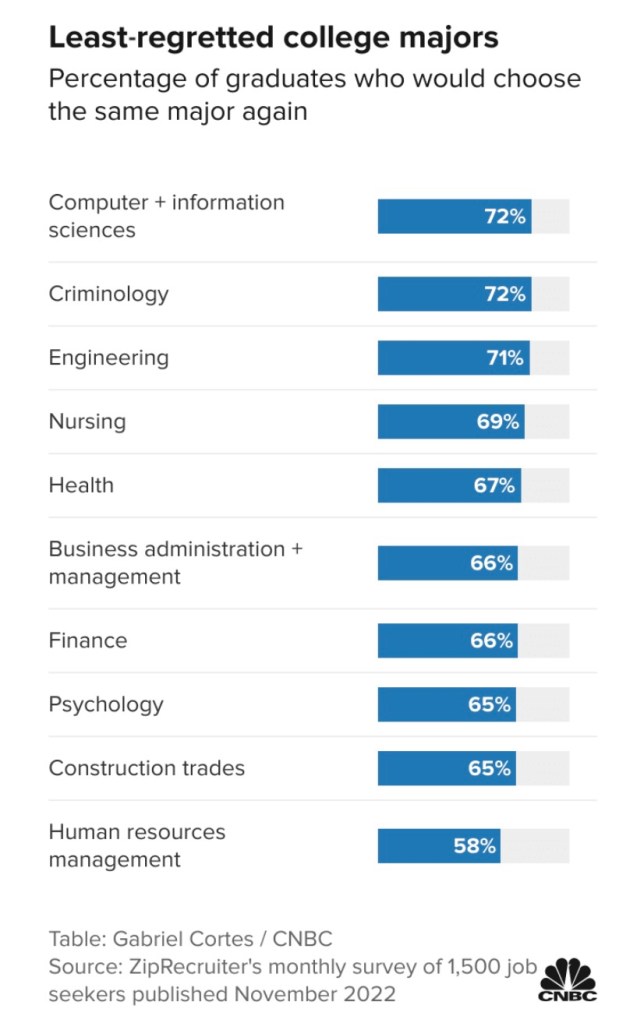
Student loan debt is top of mind to many college grads these days. The promise of high paying jobs that would not only cover the debt but also provide a lifetime of satisfaction has left many regretting their majors. CNBC shared the 10 most regretted majors and the 10 majors grads wished they had pursued instead. Dive in to see which of your majors made the list.

10 Least Valued College Majors

10 Most Valued College Majors

Where did your major fall? Least regretted or most valued? What are your thoughts? Do share. We would love to hear.

Cheers!

Career Transition: Bezos Minimization Framework…

The first step towards getting somewhere is to decide that you are not going to stay where you are.

J.P. Morgan

The Regret Minimization Framework is a simple mental model to minimize the number of regrets in the long run. Jeff Bezos after a conversation with his boss asked himself what he would regret more when he was 80 years old: Trying to build something he had strong conviction in and failing, or failing to give it a try? He realized that not trying would haunt him every day (Utkarsh Amitabh HBR).

Walking away from a great job is not an easy decision. I know that because I did it. I walked away from a great career in the pharmaceutical industry. Naturally, this decision came with it’s fair share of ups and downs but when you decide to make a decision based on purpose, all you need to do is weigh the consequences. Like Bezos did, he considered himself at age 80 and thought about it in the context of regret. If you know Amazon, then the rest is history.

As a Certified Professional Coach who specializes in career transitions and people management, I have help many leaders become clear on the next step in their career journey. It may not mean that you want to venture out into entrepreneurship. It might very well be that you want to shift into a new career in the same company or another. I reflect on a client who left his career in the financial industry to venture into a new career in social work. Hmmm, pretty drastic change, right? But the change proved satisfying.

So what’s your plan? What’s your purpose? What’s your passion? Can’t figure it out? Let’s connect.

Have a success story? Do share, we would love to hear.

Cheers!

11 Top Habits Of High Achievers…


Small daily improvements over time lead to stunning results. ~Robin Sharma

Inc shared Christina DesMarais 25 Simple Daily Habits That Separate High Achievers From Everyone Else Here I Share my top 11 favs from her list.

Top Habits of High Achievers

  1. Every morning, delegate, defer, and delete.
  2. Start every day very early
  3. Get outdoors for physical activity.
  4. Focus on quality, not quantity.
  5. Set aside 30 minutes to focus on long-term improvements
  6. Make time for joy.
  7. Start the day with meditation.
  8. Listen, read, and create something new.
  9. Never book more than half your day.
  10. Put creativity back on your to-do list.
  11. Visualize success

Personal Favs

Of the traits the two that stand out are delegate, defer and delete. Too often we try to do everything ourselves without delegating or deferring to those aptly capable. Often too we hold onto stuff that we have been doing for years not realizing the process is no longer applicable and should be …yup…deleted.

My other fav is Never booking more than half our day with meetings. I have have known colleagues who book their entire day without thinking about when they will find time to check emails or communicate with issues awaiting their approval. What then happens is the rush to work late nights, weekends and holidays. Years ago I was as guilty as charged. Then I learnt. Balance is important.

How about you? Any that stands out for you? Do share. We would love to hear.

Cheers!

5 Points To Consider When Transitioning Into A New Career…

img_5415

It’s the New Year and often it comes with a time of reflection. Several calls came from individuals who hold senior positions in their organizations enquiring how they could transition from one career to the next especially at their level. A few wanted to maintain the same salary level due to financial obligations. Others had children who already finished college and was therefore more flexible and willing to take a pay cut and sacrifice to make the change.

Neither is wrong. Life involves change, and change comes with things we have to give up or shift to achieve our desired goals. So here are 5 points to get you going into that transition if you too are experiencing a desire for change.

Steps To Progress

1. Carefully Consider the Reasons You want to Change Career

Making a serious decision based on a temporary situation is never good. For example… is it that you are working for a team that you are unhappy with? Is it because you are tired of what you’re doing? Or is it because you are faced with a personal situation that is affecting your job? Think seriously. Look before you leap.

2. Consider your Transferable Skills

What skills do you have that can be transferred into another occupation? Have you been in business long? Are you in an area that involves people skills such as banking, healthcare, other? Perhaps you have been in technology? Sales?  Journalism? Such skills can be applied to other evolving jobs.

Are your skills outdated? You may need to upgrade. Consider getting a certification in your area of your interest.

3. Research Changes in The Wider Market

If you have been too busy with your head engrossed in your job, chances are there are tons of changes in the market. Explore. One nurse shared that she never had to search for a job before. Now it seems she has to be begging recruiters to see her. She feels useless and unworthy because no one wanted to hire her after a sickness that took her out of the industry for a while. Things happen. Chin up and keep going.

4. Update Your Profile

When was the last time you looked at your Resume? LinkedIn? Do a personal name search and see what comes up? Do you like it or do you need to make changes? Search job boards to see what new opportunites exist on for example Indeed.com, LinkedIn and more.

5. Network

Last but not least, network. You May be changing industries. If so, it might be wise to start networking with others in your intended industry. Join an associations. Groups. Attend meetings. Get to know others who eventually will be able to recommend you because they are aligned with your network.

So there you have it. Here’s hoping these five points will make a difference as you or a friend contemplate a life or career change.  Need further help? Learn more in Success Strategies Book

Cheers!

Travel with Intent

A photographer's view of the world - words and images to inspire your travels and your dreams

Answering daily prompts

In this blog I'm attempting to answer wordpress daily prompts

Alex Tafur

Property Maintenance

Poesy Perspectives

embrace the magic

GREENLiGHT

When God Says Go

HEALTH | INSPIRATION

Mind • Body • Life

My Sister My Friend

Family. Youth. Parenting

Kamileon Photography

Your Focus. Our Lens.